

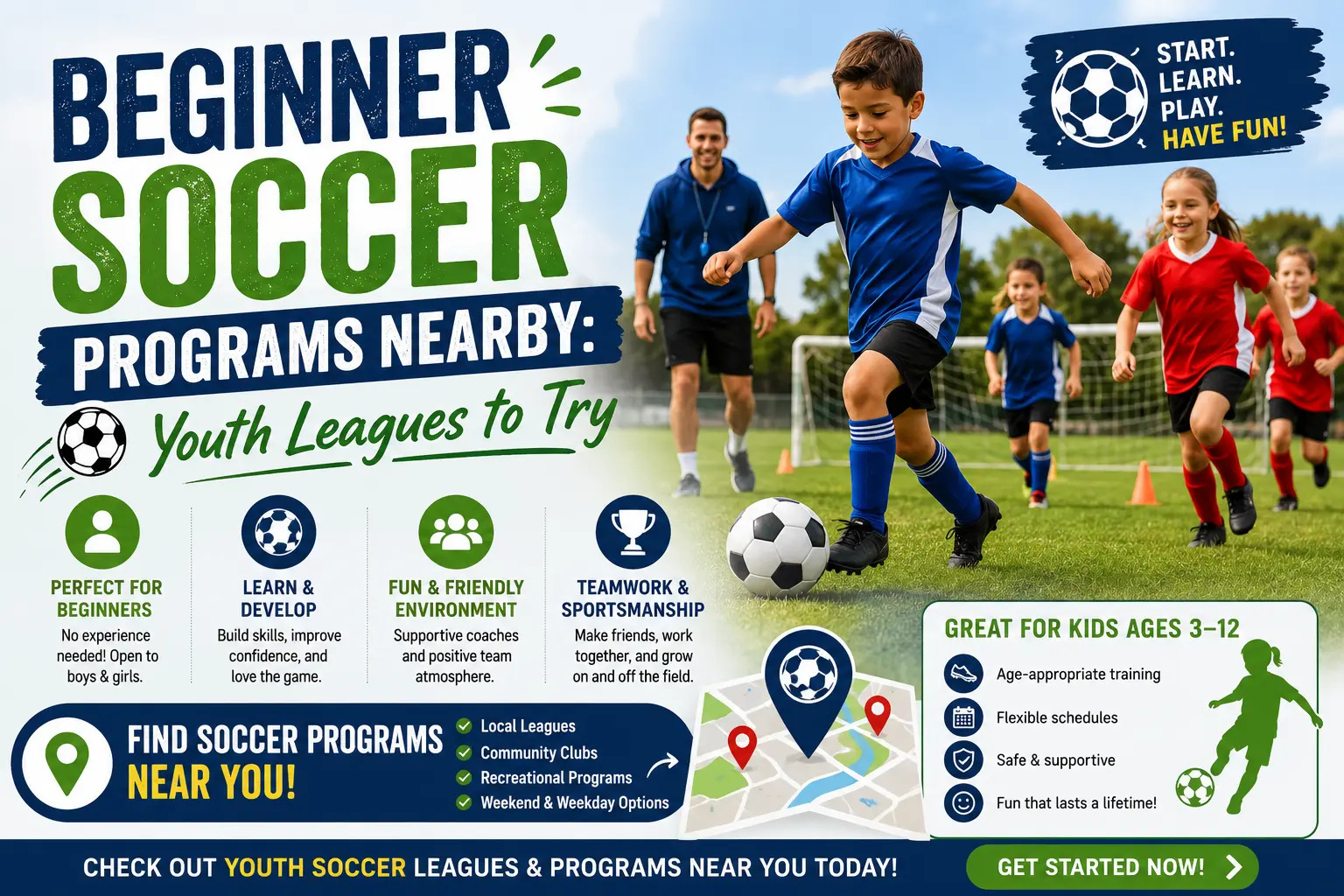
So your child wants to play soccer. Maybe they watched a game on TV. Maybe a friend at school plays on a team. Maybe they just love to run and kick a ball around the yard. Whatever the reason, you are now asking a very common question: what youth sports leagues offer beginner soccer programs nearby?
The good news is that there are many choices. Soccer is one of the easiest sports for kids to start. You do not need much gear. The rules are simple to learn. And almost every town has some kind of league, club, or class for new players.
The hard part is knowing where to look and what to pick. There are big national groups, small town clubs, school programs, paid classes, and free community games. Each one works a little differently. This guide breaks it all down in plain words, so you can find the right beginner soccer program for your child without stress.
By the end of this post, you will know:
- Which types of youth sports leagues offer beginner soccer programs
- How to find them near your home
- What age groups they usually serve
- What questions to ask before you sign up
- How much you might pay, and how to save money
- How to help your child enjoy the first season
Let’s start with the basics.
Why Soccer Is a Great First Sport for Kids
Before we look at leagues, it helps to know why so many parents choose soccer first. Here are the main reasons.
It is easy to start
A new player needs only a few things: a ball, shin guards, soccer shoes (or sneakers at first), and a water bottle. Compare that to sports like hockey or football, where the gear can cost a lot. Soccer is friendly to your wallet.
It builds the whole body
Soccer has a lot of running, turning, jumping, and kicking. Kids build strong legs, good balance, and better coordination. They also build stamina, which means they can play longer without getting tired.
It teaches teamwork
In soccer, the ball has to move from player to player. Kids learn to share, to wait their turn, and to cheer for friends. These are skills that help in school and at home too.
It is fun, even for shy kids
Beginner programs are made to be playful. Coaches use games, not long lectures. A shy child can slowly find their voice on the field while having a good time.
It grows with your child
A child can start at age 3 or 4 and keep playing for many years. Or they can try it for one season and move on. There is no pressure either way.
What Does “Beginner Soccer Program” Really Mean?
When a league says it has a beginner program, it usually means the program is built for kids who have never played, or who have played very little. Here is what you can expect.
Simple rules: Beginner games often skip hard rules like offside. The goal is to let kids touch the ball and have fun.
Small teams: Younger kids often play with fewer players on the field, such as 3 on 3 or 4 on 4. This means more touches on the ball for each child.
Short games: Games and practices are short. Little kids cannot focus for a long time, so coaches keep things quick and active.
Few or no standings: Many beginner leagues do not keep score, or they do not post league tables. The focus is on learning, not on winning.
Friendly coaches: Many coaches in beginner programs are parent volunteers. Some are trained. Others are paid staff. In both cases, the best ones are patient and positive.
Equal playing time: Good beginner programs make sure every child gets to play about the same amount.
Types of Youth Sports Leagues That Offer Beginner Soccer Programs
Now to the main question. Below are the kinds of groups that most often run beginner soccer programs. Not every group will be in your area, but most towns have at least a few of these.
1. Local recreational leagues
Recreational leagues, often called “rec” leagues, are the most common place for beginners to start. They are run by towns, cities, or volunteer groups. Anyone can join. There are no tryouts. Kids are placed on teams, and everyone plays.
What to expect:
- Low cost compared to other options
- A short season, often 6 to 10 weeks
- One practice and one game each week
- Volunteer coaches
- Teams made up of kids from the same town or school area
Rec leagues are a great fit if you want to try soccer without a big promise of time or money.
2. Parks and recreation departments
Most cities and towns have a parks and recreation department. Many of them run youth soccer programs, clinics, and camps. These are often some of the cheapest and easiest options to find.
To find them, search for the name of your town plus “parks and recreation soccer.” You can also check the department’s website or visit the office. Many publish a seasonal guide with every class and sign-up date.
What to expect:
- Programs for ages 3 and up
- Sign-ups that open a few weeks or months before the season
- Games played on town fields or in school gyms
- Clear prices and simple forms
3. AYSO and similar volunteer-run groups
In the United States, AYSO (American Youth Soccer Organization) is one of the best-known groups for beginners. It is run mostly by volunteers and is known for a “everyone plays” idea. Kids are placed on balanced teams, and each player is meant to get playing time.
Other countries have groups with a similar spirit. The main idea is the same: let all kids play, keep it friendly, and keep the cost fair.
What to expect:
- Many local “regions” or chapters
- Training for volunteer coaches
- A focus on fun, fair play, and good sportsmanship
- A season that often runs in fall, and sometimes in spring
4. US Youth Soccer and state soccer associations
US Youth Soccer is a large national group. It works through state associations, and those state groups work with local clubs. Many local clubs offer beginner or “recreational” teams along with more serious “travel” or “competitive” teams.
The key thing to know is that you do not usually sign up with the national group directly. Instead, you find a local club that is part of it. Your state soccer association’s website often has a club finder.
US Youth Soccer also supports TOPSoccer, a program for children and young people with disabilities. If your child needs a gentler, more supportive setting, ask your state association if there is a TOPSoccer program near you.
5. YMCA youth soccer
The YMCA runs youth sports in many towns. Its soccer programs are known for being friendly and focused on values like respect, teamwork, and fun. They often do not post scores or standings for young kids.
What to expect:
- Programs for toddlers through teens
- A wide mix of skill levels
- Fee help for families who need it
- Seasonal sessions, such as fall and spring
6. Boys & Girls Clubs and community centers
Boys & Girls Clubs and local community centers often have low-cost sports programs. Soccer is common. These places are good for families who want something close to home and easy on the budget.
7. Paid soccer classes for young kids
Some companies run soccer classes for toddlers and preschoolers. These are less like leagues and more like fun lessons. Names you may see include Little Kickers, Soccer Shots, and Super Soccer Stars, though what is offered depends on your area.
What to expect:
- Classes for ages around 2 to 7
- Songs, games, and stories mixed with soccer skills
- Trained staff who work with young kids all day
- Classes that are held at parks, schools, preschools, or indoor spaces
These classes are a nice first step before joining a full league. They can build your child’s comfort and skill.
8. Local soccer clubs
Most towns have at least one soccer club. Many clubs have a “recreational” side for beginners and a “select” or “travel” side for more advanced players. Even if a club is known for strong teams, it may still have a gentle program for new players.
Clubs often add extra training, like skills clinics or small group sessions. If your child likes soccer and wants to grow, a club can be a good home for years.
9. School and after-school programs
Many elementary schools run after-school soccer clubs. Some are free. Others charge a small fee. They are handy because your child is already at school, and you do not need to drive to a new place.
Ask your child’s teacher, the school office, or the PTA about what is offered. Also check if there are intramural games, which are friendly games within the school.
10. Faith-based and church leagues
Many churches and faith groups run youth sports leagues. They are often open to people of all backgrounds, and they tend to be low-cost and welcoming. Check your local community boards to see what is near you.
11. Indoor soccer centers
If you live where the weather gets very hot, very cold, or very rainy, indoor soccer centers can be a great pick. They run leagues and classes all year long. The fields are smaller, so the game moves fast and kids touch the ball a lot.
12. Camps and clinics
If your child is not ready for a full season, a one-week camp or a weekend clinic is a good way to try the sport. Camps are often held in summer and during school breaks.
How Old Does My Child Need to Be?
Most beginner soccer programs sort kids by age. Here is a simple guide. Exact ages can vary by group and by country, so always check with the league.
| Age Group | What It Usually Looks Like |
|---|---|
| Ages 2 to 3 | Parent-and-child play, ball games, and fun movement. Not real matches yet. |
| Ages 3 to 5 | Very small teams, short games, and lots of play. Often no score is kept. |
| Ages 5 to 7 | Small-sided games such as 4 on 4. Kids start to learn passing and basic positions. |
| Ages 7 to 9 | Slightly bigger teams and more game structure. Some leagues begin to keep simple standings. |
| Ages 9 to 12 | More rules, bigger fields, and more teamwork. Many kids can choose between rec and competitive play. |
| Ages 12 and up | Beginners can still start. Many leagues have “new player” or “rec” divisions for teens. |
If your child is older and has never played, do not worry. Many leagues welcome new players of all ages. Just ask if there is a division for beginners so your child is not placed with kids who have played for years.
How to Find Beginner Soccer Programs Near You
Now that you know who runs these programs, how do you actually find them in your own area? Here are the easiest ways.
Step 1: Use a simple online search
Open your search engine and try phrases like these:
- “youth soccer near me”
- “beginner soccer for kids in [your town]”
- “recreational soccer league [your town]”
- “soccer classes for toddlers near me”
- “[your town] parks and recreation soccer”
Try a few versions. The results will often show clubs, classes, and town programs you did not know about.
Step 2: Check your town or city website
Look for the parks and recreation page. Most list all youth sports, with dates, prices, and sign-up links. This is often the fastest way to find a low-cost beginner program.
Step 3: Visit your state or national soccer association
Most countries and regions have a main soccer body. Many have a “find a club” tool on their site. This helps you see which clubs are official and which ones have beginner teams.
Step 4: Ask your child’s school
Teachers, coaches, and the school office often know about local programs. Some schools also send flyers home or share news in a newsletter.
Step 5: Ask other parents
This might be the best tip of all. Parents at school drop-off, neighbors, and friends know which leagues are friendly and well run. Ask what they like and what they do not.
Step 6: Check local social media groups
Many towns have community groups on social media. Parents often post about sign-up dates, new classes, and open spots. You can also ask there: “What youth sports leagues offer beginner soccer programs nearby?” You may get many helpful answers in one afternoon.
Step 7: Look at community boards
Libraries, grocery stores, coffee shops, and community centers often have boards with flyers. Do not skip this old-school method.
Step 8: Drive by the fields
If you see kids playing soccer at a local field, take a moment to look for a sign. It will often have the name of the league and a way to contact them.
Beginner Soccer Programs Outside the United States
Soccer, also called football in most of the world, has youth programs almost everywhere. The names change, but the idea is the same. Here are a few examples of how it works in different places.
- United Kingdom: Local football associations and grassroots clubs run “mini-soccer” for young children. Many clubs have teams for kids under 7, under 8, and so on.
- Canada: Provincial soccer associations list clubs, and many clubs have “Timbits” or recreational programs for little ones.
- Australia: Many clubs run “MiniRoos” programs, which are made for young children and use small games.
- India: The national football body runs youth and “baby league” programs, and many local academies and school clubs offer beginner training for kids.
- Other countries: Check your national football federation website and look for grassroots or youth programs.
No matter where you live, a good first move is to search for your national or regional soccer association and look for a club finder or a list of grassroots programs.
Questions to Ask Before You Sign Up
Once you find a few options, call or email each one. Here are good questions to ask. Having a list makes the call quick and clear.
About the program
- Is this program for true beginners?
- What ages does it serve?
- How long is the season?
- How many practices and games are there each week?
- How long is each practice and game?
- Do you keep score or post standings?
- How many kids are on each team?
About the coaches
- Are the coaches trained?
- Are background checks done on coaches and volunteers?
- Do coaches learn about child safety and first aid?
- Can parents watch practice?
About cost
- What is the total cost?
- Does the fee include a uniform, a ball, or a team shirt?
- Are there extra fees for tournaments, pictures, or fundraising?
- Is there a discount for siblings?
- Is there financial help if we need it?
About time and place
- Where are the fields?
- Which days and times are practices and games?
- What happens if it rains or the weather is bad?
- Is there a way to swap or cancel if something comes up?
About the culture
- What is your idea about winning and losing for young kids?
- How do you make sure every child plays?
- How do you handle parents who yell from the sideline?
The answers will tell you a lot. A good league will be glad to answer. If a program seems unclear or pushy, keep looking.
How Much Do Beginner Soccer Programs Cost?
Prices change a lot from place to place, so there is no single number. Here is a general idea of how costs compare.
Lowest cost: Parks and recreation programs, school programs, community centers, and church leagues are often the most affordable. Some are even free.
Middle cost: YMCA programs, AYSO-style leagues, and local rec clubs usually fall in the middle. Fees often cover a uniform and a season of games.
Higher cost: Private classes for toddlers, indoor soccer centers, and camps often cost more, because you are paying for trained staff, indoor space, or extra coaching.
Hidden costs to watch for
Ask about costs beyond the sign-up fee. These may include:
- Shin guards, cleats, and a ball
- A team uniform or socks
- Late sign-up fees
- Fundraiser requirements
- Travel to far-away games
- Snack duty or team party costs
Ways to save money
- Buy used cleats and shin guards from a swap group or a second-hand shop.
- Ask if the league has a gear swap day.
- Sign up early, since many leagues give early bird prices.
- Ask about sibling discounts.
- Ask about scholarships or fee help. Many groups have these but do not advertise them loudly.
- Look at free community programs and open play days.
What Gear Does a Beginner Need?
Good news: you can start with very little. Here is a simple list.
Must-have items
- Shin guards: These protect the lower legs. Most leagues require them.
- Soccer socks: These hold the shin guards in place.
- Shoes: Cleats are best on grass, but sneakers can work for the first few practices. Ask the league what they prefer.
- Water bottle: Kids need to drink often, even in cool weather.
Nice-to-have items
- A size 3 ball for kids under 8, or a size 4 ball for ages 8 to 12 (check your league, since sizes can vary).
- A small bag to carry gear.
- A hat and sunscreen for sunny days.
- Warm layers for cold weather.
A tip on sizing: Do not buy gear that is too big. Shoes that are too large can cause blisters and trips. If you are on a budget, buy used gear in the right size instead.
How to Pick the Best Program for Your Child
You may find three or four good options. How do you choose? Think about these things.
Your child’s age and personality
A very young child may do best in a play-based class with a parent nearby. A confident 8-year-old may enjoy a rec league with games every weekend. A shy child may like a small group with a gentle coach.
Your schedule
Be honest about what your family can handle. A program that is close to home, with practices on days you are free, will be much easier to stick with. Missing many practices can make a child feel left out.
Your budget
Pick something you can afford without worry. Soccer is fun at every price. A free or low-cost program can be just as good as an expensive one for a beginner.
Your goals
Ask yourself what you want from this first season. Is it fun? Friends? Exercise? Learning skills? Most beginner programs give you all of these. If you hope your child will play at a higher level one day, look for a club with a clear path from rec to travel teams.
The feel of the program
Visit a practice if you can. Watch how the coach talks to kids. Do the kids look happy? Does everyone get a turn? Trust your gut. The best program is one where kids smile and want to come back.
Rec Leagues vs. Club Programs: What Is the Difference?
New parents often get confused about these two. Here is a plain comparison.
Recreational (rec) leagues
- Open to everyone
- No tryouts
- Lower cost
- Less travel
- Focus on fun and basic skills
- Volunteer coaches are common
Club or travel programs
- May need tryouts at older ages
- Higher cost
- More practices each week
- More travel to games
- More focus on skill growth and winning
- Paid or highly trained coaches are common
For a true beginner, a rec program is almost always the best place to start. If your child falls in love with the game, you can always move to a club later.
What Will the First Practice Look Like?
Knowing what to expect can calm your nerves, and your child’s too. A typical beginner practice might go like this.
- Warm-up (5 to 10 minutes): Kids jog, stretch, and play a simple tag game.
- Ball skills (10 to 15 minutes): Players dribble, stop the ball, and kick it. Coaches often use cones and fun challenges.
- Small game (15 to 20 minutes): Kids play a small match, often 3 on 3 or 4 on 4.
- Cool-down and chat (5 minutes): The coach says what went well, and the team cheers together.
Many coaches use storytelling and games to make skills fun. For example, kids might pretend to be “sharks” chasing “fish” while they dribble. It looks silly, but it works.
Tips to Help Your Child Enjoy Their First Season
The first season sets the tone. Here are easy ways to help your child love the game.
Keep it positive
Cheer for effort, not just goals. Say things like “I loved how hard you ran” or “That was a great pass.” Kids who feel safe to make mistakes will learn faster.
Let the coach coach
It is tempting to shout instructions from the sideline. But this can confuse a child. Let the coach lead, and be the loudest cheerleader instead.
Arrive early
Get to practice a few minutes early. This helps a child settle in, meet friends, and feel ready.
Pack a good snack and water
Hungry kids get grumpy. Pack water and a light snack for after the game, like fruit or a small sandwich.
Practice at home, but keep it light
Kick a ball in the yard for 10 minutes. Play a game of “copy me” with simple moves. Do not turn it into homework. The goal is play.
Do not compare
Every child learns at a different pace. Some kids are fast. Others take time. Both are fine.
Talk about the game after
Ask open questions, like “What was your favorite part?” This is better than “Did you win?” It keeps the focus on joy.
Teach good sportsmanship
Teach your child to shake hands, say “good game,” and thank the coach and referee. These habits last for life.
Safety Tips for Young Soccer Players
Soccer is a safe sport when done the right way. Still, a few simple steps can protect your child.
- Always use shin guards.
- Check the field: Look for holes, rocks, or wet spots that can cause slips.
- Drink water: Kids can get tired and overheated quickly in hot weather.
- Dress for the weather: Wear layers when it is cold, and light clothing when it is hot.
- Warm up first: A short warm-up can lower the chance of strains.
- Know the signs of injury: If a child complains of pain, has swelling, or limps, stop play and get help.
- Learn about head injuries: If a child bumps their head and seems dizzy, confused, or sick, they should stop playing and see a doctor.
- Ask about safety rules: A good league will have clear safety rules and trained staff.
Common Worries Parents Have (And Simple Answers)
“My child has never played. Will they feel left behind?”
Beginner programs are made for exactly this. Everyone is learning together. Coaches in these programs are used to kids who do not know how to kick or stop the ball yet.
“My child is shy. What if they do not like it?”
Try a short class or a small group first. Many shy kids open up after a few weeks. If it is not a fit, that is okay. You can try another sport or another year.
“We are very busy. Can we still do this?”
Yes. Look for programs with one practice and one game a week. Some parks and recreation programs have just one session a week, which is easy to fit in.
“What if we cannot afford it?”
Ask about scholarships, sliding fees, and free programs. Many leagues have funds to help families. Also check community centers and school clubs.
“What if my child wants to quit?”
Talk to them kindly and find out why. Sometimes it is a small problem, like not liking a coach or being nervous about games. You may be able to fix it. If they truly do not enjoy it, it is fine to stop after the season ends. Try to finish the season when you can, since it teaches kids to keep their promises to a team.
“Is it too late to start?”
No. Many kids start at 8, 10, or even 12 and still enjoy the game. Look for a beginner or new-player division.
Beginner Soccer Options for Kids With Special Needs
Every child deserves a chance to play. Many leagues and groups now have programs for children with physical, learning, or developmental needs.
Look for:
- Adaptive or inclusive soccer programs: These adjust the rules and pace so all kids can take part.
- TOPSoccer: In the United States, this program is supported by US Youth Soccer and is made for children with disabilities.
- Special Olympics programs: Many areas have local Special Olympics teams and training sessions.
- Buddy systems: Some leagues pair kids with helpers who guide them during play.
When you call a league, be open about your child’s needs. Ask how they can help. Most coaches and staff will be glad to find a way to make it work.
Girls and Boys Soccer: Is There a Difference at the Beginner Level?
At the beginner level, most programs are mixed for young kids, which means boys and girls play together. As children get older, many leagues split into girls teams and boys teams. Some leagues also offer girls-only programs, which can help girls feel more at ease and build confidence.
If you want a girls-only or boys-only program, ask the league what it offers. If your area does not have one, a mixed program is still a great place to start.
A Simple Checklist for Your Search
Use this quick list to stay organized as you look for beginner soccer programs near you.
- Decide your budget and your family schedule.
- Search online and check your town website.
- Ask friends, neighbors, and your child’s school.
- Make a short list of three to five programs.
- Call or email each one with your questions.
- Visit a practice or a free trial if possible.
- Compare cost, location, and feel.
- Sign up early, since popular programs can fill up.
- Buy the basic gear.
- Talk to your child and get them excited.
Best Times of Year to Sign Up
Soccer seasons vary by location, but here is a general idea.
- Fall season: Often the most popular. Sign-ups may open in late summer, and sometimes even in spring.
- Spring season: Sign-ups often open in winter.
- Summer camps: Sign-ups often open in spring.
- Indoor leagues: Often run all year, with new sessions starting every few weeks.
A good tip: if you are not sure, call or check the website in the month before you want to start. Some programs fill up fast, so earlier is better.
How to Tell If a League Is a Good One
Not all programs are equal. Here are signs of a strong, healthy league.
Green flags
- Clear info on fees, dates, and rules
- Coaches who are trained and background checked
- A focus on fun and learning for young kids
- Equal playing time for all
- A code of conduct for parents and coaches
- Quick, friendly answers to your questions
Red flags
- Very pushy sales talk
- Hidden fees
- No clear safety rules
- A “win at all costs” attitude for little kids
- Coaches who yell at children
- No way to reach anyone with questions
If you see red flags, it is fine to walk away and keep looking.
The Bigger Picture: What Soccer Teaches Kids
A beginner soccer program is about more than kicking a ball. Over time, your child may learn:
- Confidence: Trying something new and getting better is a big win.
- Resilience: Missing a goal, losing a game, or falling down teaches kids to get back up.
- Teamwork: Kids learn that everyone has a job and everyone matters.
- Healthy habits: Active kids are more likely to grow into active adults.
- Friendship: Many kids make some of their best friends on a team.
These lessons last long after the season ends.
Frequently Asked Questions
What youth sports leagues offer beginner soccer programs nearby?
Most areas have several choices. These often include parks and recreation leagues, AYSO-style volunteer leagues, local clubs that belong to a state or national soccer group, YMCA programs, community centers, school clubs, church leagues, and paid classes for toddlers. The best way to find the ones near you is to search online, check your town website, and ask other parents.
What is the best age to start soccer?
Many kids start around age 3 to 5 in play-based programs. But there is no wrong age. Older kids can start too, as long as they join a beginner-friendly division.
Do I need to buy expensive gear?
No. Shin guards, socks, shoes, and a water bottle are enough to start. Used gear works well.
Are there free beginner soccer programs?
Often, yes. Some schools, community centers, parks departments, and non-profit groups offer free or very low-cost soccer. Ask around and check local websites.
Should my child join a rec league or a club?
For most beginners, a rec league is a better first step. It is friendly, low-cost, and low-pressure. You can move to a club later if your child wants more.
How long is a typical beginner soccer season?
Most seasons run from 6 to 12 weeks. Classes and clinics may be shorter, such as 4 to 8 weeks or even a single weekend.
Can parents stay and watch?
Most programs welcome parents. Some classes for toddlers even need a parent to join in. Always check the league rules.
What if my child does not like their team?
Talk with the coach or league leader. Many programs can help fix small problems. If it still does not work, you can try another league next season.
Final Thoughts
So, what youth sports leagues offer beginner soccer programs nearby? The honest answer is: probably more than you think. From town leagues and YMCA programs to AYSO-style groups, local clubs, school teams, and fun classes for toddlers, there is almost always a place for a new player to start.
The best way to begin is simple. Search online, check your local parks and recreation page, and ask other parents. Make a short list, call a few programs, and ask smart questions. Then pick the one that fits your child, your schedule, and your budget.
Remember that the first season is not about trophies. It is about fun, friends, and a love of movement. If your child comes home with muddy shoes, a big smile, and a story about their day, the program is doing its job.
So grab a ball, lace up those shoes, and take the first step. Your young player may be just one practice away from a lifelong love of the game.
