Online games are everywhere. You can play them on your phone, your laptop, your game console, or even your smart TV. But if you are new to the world of online gaming, all the names and terms can feel confusing. What is a “battle royale”? What does “MMO” mean? Why do some games need a strong internet connection while others do not?
This guide will explain everything in simple words. By the end, you will understand the main types of online games, how each one works, and which type might be the best fit for you.
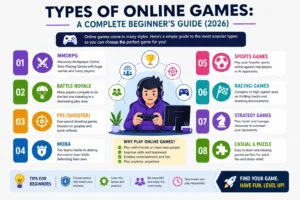
What Does “Online Game” Actually Mean?
Before we jump into the types, let’s answer a simple question: what makes a game an “online game”?
An online game is any game that needs an internet connection to work, at least in part. This is different from an “offline game,” which you can play without connecting to the internet at all.
Online games let you do things that offline games cannot, such as:
- Play with or against other real people, not just computer characters
- Save your progress on the internet, so you can continue on a different device
- Get new content added to the game after you have already downloaded it
- Chat, team up, or compete with friends and strangers
- Join large communities of players who enjoy the same game
Now that we understand the basic idea, let’s look at the different types of online games you will come across.
1. Massively Multiplayer Online Games (MMOs)
MMOs are online games where thousands, or even millions, of players can be in the same game world at the same time. The word “massively” is used because so many people can play together in one shared space.
How MMOs Work
In an MMO, you usually create a character, choose how it looks, and then explore a large virtual world. You might fight monsters, complete quests, build things, or talk to other players. Since the game world is shared, you might run into other real players while you explore.
Popular Sub-Types of MMOs
- MMORPGs (Massively Multiplayer Online Role-Playing Games): These focus on your character’s story and growth. You level up, get new gear, and complete quests. Think of games where you build a hero over time.
- MMOFPS (Massively Multiplayer Online First-Person Shooter): These combine the “shared world” idea with shooting-based combat.
- MMO Strategy Games: These focus on building bases, managing resources, and planning attacks against other players.
What Makes MMOs Different From Other Games
One big difference is that MMO worlds usually keep existing even when you log off. Other players keep playing, the world keeps changing, and new events keep happening. When you log back in, you are stepping back into a living world, not starting fresh each time.
Another difference is the sense of community. Many MMOs have guilds or clans, which are groups of players who team up regularly. Being part of a guild can make the game feel more social, since you often chat, plan activities, and help each other complete difficult tasks.
Good and Not-So-Good Points of MMOs
Good points:
- Huge worlds to explore, often with years of content
- Strong sense of community and teamwork
- A feeling of long-term progress and achievement
Not-so-good points:
- Can take a lot of time to learn and enjoy fully
- Some MMOs require a monthly payment or in-game purchases
- New players may feel overwhelmed by the amount of content
Who Should Try MMOs?
If you enjoy long-term progress, exploring big worlds, and being part of a big community, MMOs are a great choice. Keep in mind that many MMOs take a long time to fully enjoy, since they are built for players who return again and again.
2. Battle Royale Games
Battle royale games became extremely popular in recent years. In this type of game, many players (often 50 to 100) land on one map, and the last player or team standing wins.
How Battle Royale Games Work
At the start of the match, players usually jump from a plane or start in a safe zone. They then search for weapons, tools, and supplies while the safe area of the map slowly shrinks. This forces all remaining players closer together, leading to more fights as the match continues.
Why People Enjoy Battle Royale Games
- Matches are usually short, often 15 to 30 minutes
- Every match feels different because of random item locations and player choices
- There is a clear goal: survive and be the last one left
- You can play alone (solo), with one partner (duo), or in a small team (squad)
Tips for Beginners in Battle Royale Games
- Land in a quiet area first, so you have time to collect gear before facing other players
- Focus on staying inside the safe zone rather than always trying to fight
- Play a few matches without worrying about winning, just to learn the map and controls
- Watch how experienced players move and make decisions, since this can teach you useful habits
Who Should Try Battle Royale Games?
If you like fast action, quick matches, and the thrill of survival, this type is worth trying. It’s also a fun choice if you want to play short sessions instead of committing to long games.
3. First-Person Shooter (FPS) Games
FPS games let you see the game world through your character’s eyes, as if you are looking through their own vision. Most of these games focus on shooting-based combat.
How FPS Games Work
You control a character and aim your weapon at enemies. Matches are often based on teams, where you work with others to complete goals like capturing points, planting objects, or simply defeating the other team.
Common FPS Game Modes
- Team Deathmatch: Two teams fight, and whoever gets the most eliminations wins.
- Search and Destroy / Bomb Defusal: One team tries to plant or defend an object, while the other team tries to stop them.
- Capture the Flag: Teams try to steal an item from the enemy base and bring it back to their own base.
Skills That Help in FPS Games
FPS games reward a mix of physical and mental skills. Good aim is important, but so is map knowledge, since knowing where enemies usually hide can give you an advantage. Communication also matters a lot in team-based modes, since letting your teammates know where enemies are can help your whole team win.
Many beginners find FPS games hard at first because everything happens quickly. This is completely normal. Most players improve steadily with practice, and many games include easier modes or bots (computer-controlled players) to help you learn safely before facing real opponents.
Who Should Try FPS Games?
If you enjoy quick reflexes, teamwork, and competitive matches, FPS games are a strong option. They reward practice, so the more you play, the better you tend to get.
4. Third-Person Shooter (TPS) Games
TPS games are similar to FPS games, but the camera is placed behind your character instead of inside their eyes. This lets you see your character’s whole body while you play.
Some players prefer this view because it gives a wider look at the surroundings, which can make it easier to notice enemies or obstacles nearby.
Why Some Players Prefer TPS Over FPS
Seeing your own character can make the game feel more personal, since you get to watch their movements, outfits, and actions during gameplay. It can also help with awareness of your surroundings, since you are not limited to a narrow view straight ahead. Many beginners find TPS games slightly easier to get used to, since the wider camera angle makes it simpler to judge distance and spot danger early.
Who Should Try TPS Games?
If you like shooting-based gameplay but want a wider view of the action, or you enjoy seeing your character while you play, TPS games are worth trying.
5. Multiplayer Online Battle Arena (MOBA) Games
MOBA games are team-based strategy games where two teams try to destroy each other’s base while defending their own.
How MOBA Games Work
Each player controls one character, often called a “hero” or “champion,” and each character has special skills. Players work together, gain experience, collect gold, and buy items to grow stronger as the match goes on. The main goal is to push forward and destroy the enemy’s main structure.
Why MOBAs Are Popular
- Every character plays differently, so there is a lot to learn and master
- Teamwork and communication matter a lot
- Matches often reward smart planning, not just fast reactions
Common Roles in MOBA Games
Most MOBAs ask players to pick a role before a match, so the team has a good balance. Common roles include:
- Damage dealers: Characters focused on attacking and defeating enemies
- Tanks: Characters built to absorb damage and protect their team
- Support: Characters that help teammates by healing them or boosting their abilities
Understanding these roles early can help beginners choose a character that matches their preferred playstyle.
Who Should Try MOBAs?
If you enjoy strategy, teamwork, and learning different characters with unique skills, MOBAs can keep you interested for a long time. They do have a learning curve, so expect some time to get comfortable with the basics.
6. Real-Time Strategy (RTS) Games
RTS games ask you to build, manage, and command an army or base, all while the game keeps running in real time (unlike turn-based games, where you wait for your turn).
How RTS Games Work
You usually gather resources, build structures, train units, and use those units to attack or defend. Since everything happens at the same time for both players, quick thinking and multitasking are important skills.
Why RTS Games Can Be Challenging for Beginners
RTS games often require you to do many things at once, such as building your base, training units, and attacking the enemy, all within the same few minutes. This can feel overwhelming at first. Many RTS games include training modes or easier difficulty settings, which are a good place for beginners to start before playing against real people online.
Who Should Try RTS Games?
If you like planning, managing resources, and outsmarting your opponent through strategy, RTS games are worth exploring. They can be intense, since every second matters.
7. Sports and Racing Games
These online games are based on real-world sports (like football, basketball, or soccer) or racing (like cars, bikes, or even space vehicles).
How They Work Online
You can play matches against other real players instead of just the computer. Many sports games also let you build your own team, trade players, or join online leagues with other fans.
Extra Features in Online Sports and Racing Games
Beyond simple matches, many of these games offer online leaderboards, seasonal events, and career modes where you can track your growth over time. Racing games often let you customize your vehicle’s look and performance, while sports games often let you manage a full team, including transfers and training.
Who Should Try Sports and Racing Games?
If you already enjoy watching or playing real sports, or you love speed and competition, these games offer a fun online version of that excitement.
8. Simulation Games
Simulation games try to copy real-life activities, such as farming, flying planes, running a city, or managing a business. Many simulation games now include online features, letting you visit other players’ creations or trade resources with them.
Examples of What You Can Simulate
Simulation games cover a huge range of activities. Some let you manage a farm and grow crops. Others let you build and run a theme park, a hospital, or a whole city. There are also simulation games focused on flying planes or driving trucks over long distances, which appeal to players who enjoy realistic, detailed experiences.
Who Should Try Simulation Games?
If you enjoy slow, relaxing gameplay and building things step by step, simulation games are a calm and rewarding choice.
9. Sandbox and Building Games
Sandbox games give players freedom to build, create, and explore without strict rules or a fixed storyline. Online sandbox games let you build alongside friends or even strangers in a shared world.
How Sandbox Games Work
You are usually given tools and materials, and it’s up to you how you use them. Some players build houses, others build entire cities, and some just enjoy exploring what other players have created.
Why Sandbox Games Are Popular With All Ages
Sandbox games are popular with players of many ages because they do not force you to follow a strict path. You can set your own goals, whether that means building a giant castle, creating a small village, or simply exploring the world other players have made. Because there is no single “correct” way to play, sandbox games tend to feel relaxing and low-pressure compared to competitive game types.
Who Should Try Sandbox Games?
If you enjoy creativity and want a game with no pressure to “win,” sandbox games are a great fit, especially for players who like building things their own way.
10. Card and Board Games (Online Versions)
Many classic card and board games now have online versions. This includes card battle games, trivia games, and traditional board games played over the internet.
How They Work
You play against other real people online, often taking turns. Some games also add special rules, characters, or abilities to make the classic game more exciting.
Who Should Try Online Card and Board Games?
If you enjoy games that involve thinking, planning, and a bit of luck, this type is relaxing and easy to pick up, even for complete beginners.
11. Puzzle Games
Puzzle games challenge your brain instead of your reflexes. Online puzzle games often let you compete for the fastest time or the highest score against other players.
Why Puzzle Games Work Well for Beginners
Puzzle games are one of the easiest types of online games to start with, since most of them explain their rules within the first few minutes. They also work well for short breaks, since a single round often takes just a few minutes to finish. Many puzzle games include daily challenges, which give players a reason to come back and try again the next day.
Who Should Try Puzzle Games?
If you enjoy solving problems and want a game that is easy to play in short bursts, puzzle games are a simple and fun option.
12. Fighting Games
Fighting games place two characters against each other in a one-on-one battle. Online fighting games let you challenge players from all over the world instead of just people in the same room.
How They Work
Each character usually has a set of moves, combos, and special attacks. Matches are often short, and winning depends on timing, memory, and quick decision-making.
How Beginners Can Get Started With Fighting Games
New players often feel nervous about fighting games because skilled players can seem incredibly fast and precise. A good way to start is by practicing basic moves against the computer before trying online matches. Most fighting games also include tutorials that slowly introduce combos, blocking, and special moves, so beginners are not expected to know everything right away.
Who Should Try Fighting Games?
If you enjoy head-to-head competition and want to master specific characters and combos, fighting games can be very rewarding once you learn the basics.
13. Idle and Casual Games
Idle games are designed to be simple and require very little effort. Many of them keep progressing even when you are not actively playing. Casual games, in general, are easy to learn and do not require long play sessions.
Why These Games Fit Busy Schedules
Idle and casual games are designed for people who do not have hours of free time. You can open the game, check on your progress, make a few quick decisions, and then close it again. Because progress often continues even while you are away, these games feel rewarding without requiring constant attention.
Who Should Try Idle and Casual Games?
If you want something light to play during small breaks in your day, without needing to focus too hard, idle and casual games are perfect.
14. Massively Multiplayer Party Games
These are simple, often silly, games where many players compete in short mini-games or challenges at the same time. They are usually easy to understand, even without instructions, making them great for playing with friends or family.
Who Should Try Party Games?
If you want a fun, light-hearted game to enjoy with a group, party games are one of the easiest types to jump into.
How to Choose the Right Online Game as a Beginner
With so many types of online games, it can be hard to know where to start. Here are some simple tips:
- Think about how much time you have: Battle royale, FPS, and party games usually have short matches. MMOs and simulation games are better for longer play sessions.
- Think about whether you prefer teamwork or solo play: MOBAs, FPS, and RTS games often need teamwork. Puzzle games and idle games can be enjoyed alone.
- Think about how competitive you want to be: Fighting games, MOBAs, and shooters are highly competitive. Sandbox, simulation, and casual games are more relaxed.
- Try free versions first: Many online games offer free access, so you can test a few types before deciding what you enjoy most.
- Don’t be afraid to start slow: Every experienced player was once a beginner. Take your time learning the basic controls and rules before jumping into competitive matches.
Basic Terms Every Beginner Should Know
To help you feel more confident, here are a few common words you’ll hear in online gaming:
- Lobby: The waiting area where players gather before a match starts.
- Ping: A measure of your internet connection speed. Lower ping usually means a smoother, faster experience.
- Respawn: When your character comes back to life after being defeated.
- Grinding: Repeating tasks in a game to gain experience, items, or currency.
- Patch: An update released by the game developers to fix problems or add new content.
- Matchmaking: The system that pairs you with other players of a similar skill level.
What You Need to Play Online Games
Different online games have different requirements, but most beginners will need the following:
- A stable internet connection: Fast-paced games like FPS and battle royale games work best with a strong, steady connection, since delays can affect your gameplay.
- A suitable device: This could be a smartphone, tablet, computer, or gaming console, depending on the game.
- An account: Most online games require you to create a free account so your progress can be saved and shared across devices.
- Enough storage space: Some online games, especially MMOs and sandbox games, can take up a large amount of storage space on your device.
Staying Safe While Playing Online Games
Since online games connect you with other real people, it is important to keep a few safety habits in mind, especially as a beginner:
- Avoid sharing personal information, such as your full name, address, or school, with strangers in the game
- Use strong, unique passwords for your gaming accounts
- Be cautious of links or offers that seem “too good to be true,” since these are sometimes scams
- Report any players who behave in a harmful or inappropriate way, since most games have built-in reporting tools
- Take breaks between long play sessions to rest your eyes and body
Final Thoughts
Online games come in many shapes and sizes, from fast-paced shooters to calm simulation games, and from strategy-heavy MOBAs to simple, relaxing puzzle games. There is truly something for every type of player.
As a beginner, the best approach is to explore a few different types, see what feels enjoyable, and slowly build your skills from there. Gaming should be fun first, so don’t worry about being perfect right away. Take your time, learn as you go, and enjoy discovering the type of online game that suits you best.