Every year, thousands of high school basketball players dream of playing in college. A small group of them become household names long before they play a single college game. Fans follow their stats, watch their mixtape videos, and argue about which school will land them.
Much of that buzz starts with one thing: a list. The 247 Sports basketball recruiting rankings are among the most popular lists in the sport. Coaches check them. Fans share them. Players and parents watch them closely.
But what do these rankings really mean? How do the stars work? Why does a player jump up seven spots in one week? And does a high ranking mean a player will become a college star or an NBA pick?
This guide answers those questions in plain words. You will learn how the rankings are made, how to read them, who the top college prospects are right now, and how to use the rankings without being fooled by them.
Note: Rankings change often. The names and numbers below are based on reports available in early October 2026. Always check the live 247Sports site for the newest list.
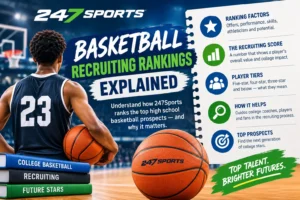
What Are 247 Sports Basketball Recruiting Rankings?
247Sports is a sports media company that covers college sports recruiting. For basketball, its staff watches high school players across the country and ranks them from best to worst within each graduating class.
A “class” is a group of players who finish high school in the same year. For example, the Class of 2027 is made up of players who will graduate high school in 2027 and, in most cases, start college that fall.
So when you see a “2027 ranking,” it is a list of the best high school players in that group. Number 1 is the player the scouts think is the best. Number 2 is the next best, and so on, usually down to 100 or even more names.
These lists do a few jobs at once:
- They help fans learn who the best young players are.
- They show college coaches how the public sees a player.
- They give players and families a rough sense of how they compare nationally.
- They give writers and fans something fun to debate.
The rankings are not a rule book. No school has to follow them. A coach can love a player the lists ignore, and a coach can pass on a player the lists love. But because so many people read them, the rankings carry real weight in the recruiting world.
Who Makes the Rankings?
The 247Sports rankings come from people, not from a computer formula. Basketball analysts and scouts watch players in many settings:
- High school games
- Summer travel-team events (often called AAU or grassroots basketball)
- Showcases and camps
- National team events
- All-star games
They also talk to coaches, trainers, and other scouts. They watch video. Over time, they build a picture of each player’s skills, size, and future.
Because people make the lists, opinions play a part. Two smart scouts can watch the same player and come away with different views. One may love a big man’s shooting touch. Another may worry that he is too slow. That is why rankings from different companies do not match exactly.
Two Kinds of Lists: The 247Sports Ranking and the Composite
This part confuses a lot of new fans, so let’s make it simple. There are two main lists you will see on 247Sports.
1. The 247Sports Ranking (the “in-house” list)
This is the list made by the 247Sports staff alone. It shows what their own scouts think. When a headline says “247Sports updates its rankings,” this is usually the list they mean.
2. The 247Sports Composite
The Composite is different. It blends the rankings from several top recruiting services into one combined score. It does not show only one company’s opinion. It shows a kind of “average view” of the whole industry.
Why does this matter? Because the two lists can tell slightly different stories. A player might be No. 3 on one list and No. 5 on the other. Neither is “wrong.” They are just built differently.
Here is a simple way to remember it:
- In-house ranking: “What do the 247Sports scouts think?”
- Composite ranking: “What does the whole industry think, on average?”
When you read a news story, check which list it uses. A report that says a player is “No. 4 in the latest 247Sports Composite” is talking about the blended list. A report that says a player “rose to No. 3 in 247Sports’ updated rankings” is talking about the site’s own list.
What Do the Stars Mean?
Next to a player’s name, you will often see stars. Stars are a quick way to show how highly a player is rated.
- Five-star: The best of the best. Only a small number of players earn five stars each year. These are the players most likely to become college stars and future pros.
- Four-star: Very strong players. Most high-major college teams (the big conferences) are happy to sign four-stars.
- Three-star: Solid players who often become good college starters and contributors, especially on mid-level and strong mid-major teams.
- Two-star and below: Players who may be talented but are less known or less developed. Many go on to have fine careers anyway.
The star number comes from a rating. On the Composite, the rating is a number close to 1.0000. A very high number, such as 0.9956, shows a player near the top of the class. One recent report listed a 2027 recruit with a Composite rating of 0.9956, which placed him 12th nationally. You can see how small the gaps are between players near the top. The difference between a 0.9956 and a 0.9888 is tiny on paper, but it can mean a jump of many spots in the ranking.
You do not need to memorize the exact rating cut-offs. What matters is the idea: a higher number means a higher ranking, and the top group gets the fifth star.
What Do Scouts Look For?
When scouts rank a player, they are not only counting points per game. They ask bigger questions. Here are the main things they judge.
Size and Body
Height, arm length (called wingspan), and body strength matter, especially for big men and forwards. A player who is tall with long arms can block shots, grab rebounds, and finish near the rim. A scout will also ask whether the player is still growing or getting stronger. A player who is working hard to build his body may rise in the rankings later.
Skill
Can he shoot from long range? Can he pass? Does he handle the ball well with either hand? Skill is a huge part of the grade, because modern basketball asks almost every player to do many things.
Athletic Ability
Speed, jumping, quickness, and balance all count. A player who moves well for his size gets extra credit from scouts.
Basketball IQ
This means “feel for the game.” Does he make smart reads? Does he know where to be on defense? Does he make teammates better? Some players have flashy skills but poor decisions. Others make everything look easy because they think the game so well.
Two-Way Ability
Scouts love players who help on both offense and defense. A player who can score and also guard hard is more valuable than one who only does one of those things. You will often see the phrase “two-way player” in scouting reports.
Competitiveness and Leadership
Does he play hard every night? Does he step up in big games? Scouts notice a player’s attitude and how he handles pressure. A coach in one report talked about a prospect’s competitiveness and drive to be a top player as the thing that sets him apart.
Upside
Upside means “how good could he become?” A 16-year-old who is already good but still raw may rank higher than a player who is a little better today but has less room to grow.
Why Do Rankings Change So Much?
If you follow the rankings for even a few weeks, you will see names move up and down. This is normal. Here are the main reasons.
Big Summer Events
Much of the player evaluation happens in spring and summer, during the travel-team season. Big events such as the Nike EYBL Peach Jam and the Adidas 3SSB give scouts the chance to see top players against top players in the same place.
After that season ends, the lists often get a big update. One recent example: with the AAU season finished after events like Peach Jam and Adidas 3SSB, 247Sports updated its 2027 rankings, and Kentucky target Cayden Daughtry rose seven spots to No. 3 after a standout run at Peach Jam. The same report said he scored over 30 points nearly every night on his way to winning it all. Sports IllustratedSports Illustrated
That shows how fast a ranking can change. One great week against the best players can move a prospect up a lot.
Growth and Improvement
Teenagers change fast. A player can grow a few inches, get stronger, or learn a new skill in just a few months. Scouts update their views when that happens.
International Play
Some top players also play for national teams. Great games against the best players from other countries can boost a ranking. One 2027 guard, Beckham Black, played for Team USA at the 2026 FIBA U17 World Cup. According to ESPN’s report, Team USA won that tournament, and Black led the team in assists with 8 per game and made the All-Tournament First Team. ESPN
Injuries and Slumps
A long injury can slow a player’s rise. A bad stretch can make scouts take a second look. On the flip side, a player who returns healthy and plays well can climb again.
Players Changing Classes
Sometimes a player “reclassifies.” That means he moves up a year and finishes high school early. This can shake up an entire class list. For example, two players who had been ranked No. 1 and No. 2 in the 2027 class, Babatunde Oladotun and Bruce Branch III, were moved up to the 2026 class. When the top names leave a class, everyone below them moves up.
The Class of 2027: Top College Prospects to Know
Now let’s look at real names. The Class of 2027 is the group the recruiting world is watching most closely right now. These players are expected to start college in the fall of 2027.
A few quick words about this class. Experts say it will be compared to the two classes before it, which were seen as unusually strong. One ESPN recruiting leader said it is unfair to judge 2027 against those classes, and that this group turned out to be very good on its own. That same report noted the 2027 class does not have the same star power at the very top as the last two did.
Remember: different lists put these players in slightly different orders. Treat the names below as a group of top prospects, not a final order.
Marcus Spears Jr., Power Forward
Spears is one of the most talked-about names in the class. His family is full of athletes. His father, Marcus Spears, was a former NFL first-round pick, and his mother, Alysha Spears, was an All-SEC player and top-10 WNBA draft pick.
On the court, he is known for his two-way game. ESPN’s scouting report praised his defense: he uses a 6-foot-10 frame and a 7-2 wingspan to protect the rim and take over the glass, changing plays even when he does not block the shot.
One of his coaches also said his main focus over the spring and summer was improving his body. That fits with what scouts want to see: a talented big man who keeps getting stronger.
Beckham Black, Point Guard
Black is a 6-foot-3 point guard who plays for AB Elite. He is the younger brother of Orlando Magic guard Anthony Black. According to HoopsHQ, he has steadily climbed the rankings over the past year and sits at No. 4 in the latest 247Sports Composite.
His game is built on smart, winning basketball. As noted above, his Team USA run at the FIBA U17 World Cup helped his name. His offer list is big too. Reports say it includes Arkansas, Duke, Texas, North Carolina, Kentucky, Miami, Virginia, USC and others.
Cayden Daughtry, Point Guard
Daughtry is a 6-foot point guard who plays for the Florida Rebels. He was one of the big stories of this summer. HoopsHQ wrote that no one shined brighter than Daughtry on this year’s EYBL circuit, and he also played for Team USA at the U17 World Cup. He is said to model his game after Allen Iverson.
As we saw, his huge Peach Jam run pushed him up to No. 3 in the updated 247Sports rankings. One Kentucky writer said it cemented him as one of the best point guards in the class.
CJ Rosser, Forward
Rosser is a skilled big man from North Carolina who plays for Team United. HoopsHQ describes him as a 6-foot-10 forward with a rare mix of size and mobility. Earlier scouting from Rivals said that players his size who move so smoothly and also shoot well from long range are rare.
His recruiting is moving too. ESPN reported that he has made unofficial visits to Kentucky, North Carolina, NC State and Maryland.
Other Names Worth Watching
The top of the class is deep. Other recruits are rated near the top, and several schools are chasing them. One Kentucky report said the Wildcats are involved with nearly all of the top 15 recruits in the class. That tells you how many schools want the same few players.
Keep in mind that this is only a snapshot. The best way to see the full list is on the 247Sports website, where the rankings are updated as scouts see more.
How Rankings Fit Into the Recruiting Calendar
Rankings do not happen in a vacuum. They follow a calendar. Here is a simple view of how a recruiting year often moves.
Spring and summer: Travel-team season is in full swing. Players compete at big events. Scouts watch and write notes. Rankings can move a lot during and right after this stretch.
June 15 after sophomore year: This is a key date. It is the first day college coaches can directly reach out to players in the next class. For the Class of 2027, June 15 was the first day coaches could contact those prospects directly. After that date, you see a flood of calls, messages, and scholarship offers.
Late summer and fall: Players start setting visits. Fans watch to see which schools get the first looks. Many top players wait to decide, so most do not commit right away. As one report said about the class, most of these recruits will not be giving verbal commits to a school for quite some time.
High school season (winter): Players show what they can do against their school and league opponents. Rankings get another update.
Signing periods: Players sign their national letters of intent or other signing papers and make their choices official.
Knowing this calendar helps you understand why news comes in waves. Rankings and offers tend to cluster right after big events and key dates.
What Do Rankings Say About the NBA?
Many fans ask whether a top recruiting ranking means a player will go to the NBA. The honest answer: often, but not always.
In recent years, the top high school players have mostly gone to college for one year and then to the NBA Draft. One report noted that one-and-done freshmen took 11 of the 14 lottery spots in both 2025 and 2026. The “lottery” means the top 14 picks in the draft.
That shows how closely high school rankings and the NBA connect at the very top. Players who rank near No. 1 often become top picks.
But there is a catch. The same report noted that NIL rules make it more tempting and more profitable for players to stay in college longer. NIL stands for “name, image, and likeness.” It lets college athletes earn money from their name. Because of NIL, some players choose to stay in college for two or more years instead of leaving right away.
Also, a high ranking does not guarantee success. Some five-star players struggle in college. Some three-star players grow into stars. The ranking shows how a player looks today, not what he will be in four years.
One more note: in some cases a player may need to spend two years in college before he can enter the draft, depending on his age and eligibility. This is why a ranking of “best college prospects” and a ranking of “best NBA prospects” are not always the same list.
How NIL and the Transfer Portal Changed Recruiting
Recruiting is not what it was ten years ago. Two big changes shape it now: NIL and the transfer portal.
NIL: Colleges and the groups that support them can offer players money tied to their name and image. This has turned recruiting into a more business-like world. A top-ranked player can have many schools offering strong NIL packages.
The transfer portal: This is a system that lets college players move from one school to another more easily. Many teams now build their rosters using a mix of high school recruits and transfers. In fact, one recent report on top draft prospects even noted that a transfer player was ranked in the top group among portal players by 247Sports.
What does that mean for the high school rankings? They still matter, but they are only part of the story. Coaches look at high school players and at proven college players when they build a team. Even so, the top high school recruits remain some of the most valuable pieces in college basketball.
Mistakes Fans Make When Reading Rankings
Rankings are fun and helpful, but they are easy to misread. Here are common mistakes to avoid.
Mistake 1: Treating the Number as Fact
A ranking is an opinion. Being No. 7 does not mean a player is exactly better than No. 8. At the top of a class, the gaps are often very small. Many scouts would swap spots 5 through 12 on any given day.
Mistake 2: Ignoring the Difference Between Lists
As we covered, the 247Sports in-house ranking and the Composite are not the same thing. Do not be surprised if one list has a player at No. 3 and another has him at No. 6.
Mistake 3: Reading Too Much Into One Event
One great weekend can move a ranking a lot, but one weekend does not tell the whole story. A balanced view looks at a whole season, not one tournament.
Mistake 4: Thinking Stars Equal Success
A five-star player is more likely to succeed, but the odds are not 100 percent. Fit, coaching, health, and work habits all matter.
Mistake 5: Forgetting Players Are Still Teenagers
These are 16- and 17-year-olds. They are still growing, both in body and in skill. Rankings today are a snapshot, not a final grade.
Mistake 6: Expecting the Rankings to Predict the Winner of a Recruiting Battle
A player’s rank does not tell you where he will go. Family, school fit, playing time, coaching, and money all play a role.
How to Use the Rankings the Smart Way
Here is how different readers can get the most from the 247Sports rankings.
If You Are a Fan
Use the rankings to learn names early. Follow a few players you like. Watch their games when you can. Enjoy the debates, but remember that the lists are one view among many.
If You Are a Parent or Player
Use the rankings as one tool, not the only one. They can show how your skills compare nationally. But do not let a number define your worth. Many great players start unranked or low-ranked and grow later. Focus on getting better, finding a program where you can play and grow, and getting good coaching.
If You Are a Blogger or Writer
Always say which list you are quoting. Include the date of the ranking, since it changes. Add context, such as a player’s style, stats, and recruiting news, so your readers get more than a number.
If You Are a Betting or Pool-Style Predictor
Be careful. Rankings are not a guarantee about commitments or future success.
A Quick Guide to Reading a Player Profile
When you open a player page on a recruiting site, you will usually see the same basic items. Here is what each one tells you.
- Position: Where he plays, such as point guard, forward, or center.
- Height and weight: His size today, which may change.
- Hometown and high school or program: Where he plays now.
- Stars and rating: How highly he is rated.
- National, position, and state rank: Where he stands in the whole country, among others at his position, and in his home state.
- Offers: The schools that have offered him a scholarship.
- Visits: Schools he has visited, official or unofficial.
- Status: Whether he is still uncommitted, committed, or signed.
- Scouting report: A short written review of his strengths and weaknesses.
Reading these pieces together gives you a much fuller picture than the rank alone.
Frequently Asked Questions
What are 247 Sports basketball recruiting rankings?
They are lists that rank the best high school basketball players in each graduating class. The 247Sports staff makes one list based on its own scouting, and the site also shows a Composite list that blends several services.
How often are the rankings updated?
They are updated several times a year, with big updates often following the summer travel-team season and again during or after the high school season. Smaller changes can happen anytime.
What is the difference between the 247Sports ranking and the Composite?
The 247Sports ranking is the site’s own list. The Composite blends rankings from multiple recruiting services into one combined score.
What does a five-star recruit mean?
A five-star recruit is among the very top players in the class. Only a small group earns this rating each year.
Do the top-ranked players always go to the NBA?
Many do, often after one year in college. But not all. Some stay longer, and some struggle. A ranking shows promise, not a promise.
Why did a player rise or fall in the rankings?
Usually because of how he played at big events, how much he improved, an injury, or a change in class. Because rankings are opinions, scouts also change their views as they see more.
Who are the top 2027 basketball recruits?
Names that appear near the top of various lists include Marcus Spears Jr., Beckham Black, Cayden Daughtry, and CJ Rosser, along with others. The exact order differs from list to list and changes over time, so check the live rankings.
When do the Class of 2027 players commit?
Most top players take their time. Recruiting runs through the high school season, and many decisions come late.
Are the rankings always right?
No. They are smart opinions, and even the best scouts miss sometimes. Players develop at different speeds.
Final Thoughts
The 247 Sports basketball recruiting rankings are a great way to learn about the next wave of college stars. They give you names, ratings, and a clear sense of who the experts think is best. They also help explain why some players get so much attention long before they step on a college court.
But the smartest fans treat the rankings as a starting point. Remember the key ideas:
- Rankings are opinions made by scouts, and they change.
- The in-house list and the Composite are two different things.
- Stars show how highly a player is rated, not a guaranteed future.
- Big summer events can move a player up fast.
- A top ranking often leads to the NBA, but NIL and other changes mean more players now stay in college longer.
- Players are still teenagers, and they keep growing.
The Class of 2027 is deep, with strong guards and bigs who will be fun to watch. Names like Spears, Black, Daughtry, and Rosser are ones to keep an eye on as the season goes on. Whether you follow the rankings for fun, for your favorite school, or for your own recruiting journey, use them with an open mind, and enjoy the ride.