Have you ever watched a hockey game and asked yourself, “How many players are on a hockey team?” It’s one of the first questions new fans ask. It sounds like it should have one easy answer. But hockey has a few different answers, depending on what kind of hockey you’re talking about and what part of the game you mean.
In this guide, we will use simple words to explain everything. We will cover ice hockey, the most popular form in North America. We will also cover field hockey, since many people search for that too. By the end, you will know exactly how many players are on the ice, how many are on the bench, and how many make up a full team roster.
Let’s drop the puck and get started.
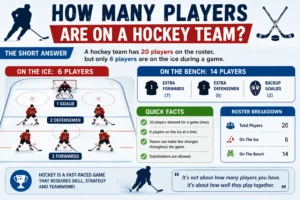
The Quick Answer
If you want a fast answer, here it is:
- Ice hockey: 6 players are on the ice for each team at one time. That is 5 skaters plus 1 goalie.
- NHL full roster: Up to 23 players can be on an NHL team. Only 20 of them “dress” (get ready to play) for each game.
- Field hockey: 11 players are on the field for each team at one time. That is 10 field players plus 1 goalkeeper.
That’s the short version. But there is a lot more to learn, and it will help you understand the game much better. So let’s slow down and look at each part closely.
Ice Hockey: 6 Players on the Ice
When people ask “how many players are on a hockey team,” they usually mean ice hockey. This is the fast game played on a frozen rink, with players wearing skates and using curved sticks to hit a hard rubber puck.
During normal play, each team has six players on the ice at the same time. These six players are:
- One goalie (also called a goaltender) — the player who stands in front of the net and tries to stop the puck from going in.
- Two defensemen — players who mostly stay back to protect their own goal.
- Three forwards — players who mostly try to score goals. These are often called the center, the left wing, and the right wing.
So the math looks like this: 1 goalie + 2 defensemen + 3 forwards = 6 players on the ice.
This is true for both teams. So when a hockey game is being played normally, there are 12 players total moving around the ice — six from each side — plus the officials (referees and linesmen) who are not part of either team.
Why Only Six Players?
You might wonder why hockey uses six players instead of more, like soccer or ten, like basketball uses five. The answer comes down to the size of the rink and the speed of the game.
An NHL ice rink is 200 feet long and 85 feet wide. That might sound big, but hockey players move extremely fast — much faster than runners on foot, because they are gliding on skates. Six players per team gives enough space for fast skating, passing, and scoring chances, without the ice becoming too crowded. If there were more players on the ice at once, it would be very hard to move around and the game would feel much slower and more crowded.
The Full Hockey Team: More Than Just Six
While only six players from each team are on the ice at once, a hockey team is made up of many more players than that. Think of it like a big group where only some people play at any given moment, while the rest wait their turn.
The NHL Roster
In the NHL (National Hockey League), which is the top professional hockey league in North America, teams can carry up to 23 players on their active roster during the regular season. But not all 23 players suit up and play in every single game.
Out of those 23 players, only 20 players dress for each game. This group of 20 is usually made up of:
- 18 skaters (this includes both forwards and defensemen)
- 2 goalies
The 18 skaters are often split into:
- 12 forwards (this makes four lines of three forwards each)
- 6 defensemen (this makes three pairs of two defensemen each)
So if you add it up: 12 forwards + 6 defensemen + 2 goalies = 20 players dressed for the game.
The three players who are part of the 23-man roster but do not dress for that particular game are called “healthy scratches.” These are players who are healthy and able to play, but the coach has chosen not to use them for that game. This might happen because the coach wants to try a different player, rest someone, or match up better against the other team.
Why Do Teams Need So Many Extra Players?
Hockey is a very physical and tiring sport. Players skate at top speed, get checked into the boards, block shots, and play through long seasons. Because of this, teams need extra players in case someone gets hurt or gets tired. Here are the main reasons a team carries more than just six players:
- Injuries: Hockey involves a lot of contact. Players can get hurt during games or practices, so backup players are needed to fill in.
- Rest: Players change on and off the ice every 30 to 90 seconds because skating at full speed is extremely tiring. Fresh legs make the team faster and stronger.
- Strategy: Coaches may want different types of players for different situations, like facing a team with a strong power play or a team that skates very fast.
- Long seasons: The NHL regular season has 82 games for each team. That is a lot of hockey, so teams need depth to stay strong all season long.
Understanding Line Changes
One of the coolest parts of hockey is how players switch in and out during play — even while the puck is still moving! This is called a “line change” or “changing on the fly.”
Instead of stopping the game every time a player gets tired, hockey allows players to skate to the bench and have a new player jump over the boards to take their place. This can happen very quickly, sometimes in just a second or two.
Teams usually use four lines of forwards and three pairs of defensemen, and they rotate through them during the game. A “line” simply means a group of players who are on the ice together. Coaches plan out which players skate together based on their skills and how well they work as a team.
This system lets players rest on the bench while their teammates are on the ice, which keeps the whole team skating at a high speed throughout the game.
Special Situations: When the Number of Players Changes
While six players per team is normal, the number of players on the ice can change during certain parts of the game. Let’s look at these situations.
Power Plays and Penalties
If a player breaks a rule, they may be sent to the penalty box for a set amount of time, usually two minutes. While that player sits in the box, their team must play with fewer players on the ice. This is called being “shorthanded.”
The other team, which still has all its players, is said to be on a “power play.” This gives them an advantage because they have more players than the other team.
Here is how the numbers can look during penalties:
- 5-on-4: One team has 5 skaters (plus their goalie) and the other has only 4 skaters (plus their goalie). This is the most common penalty situation.
- 5-on-3: This happens when two players from the same team are in the penalty box at the same time. This is a big advantage for the other team, since they have five skaters against just three.
- 4-on-4: Sometimes both teams get penalties at the same time, so each team plays with one less skater.
Pulling the Goalie
Near the end of a close game, if a team is losing, the coach might decide to “pull the goalie.” This means the goalie skates off the ice and is replaced by an extra forward. Now the team has 6 skaters and no goalie on the ice.
This is a risky move because the net is empty, meaning the other team can score very easily if they get the puck. But it also gives the losing team a better chance to score a tying goal because they have one extra attacking player. It’s a bit like an all-or-nothing gamble.
Overtime Play
If an NHL regular season game is tied after three periods, the teams play overtime. During regular season overtime, teams only use 3 skaters plus a goalie for each side, which is called 3-on-3. This smaller number of players creates more open ice and leads to more scoring chances, which helps decide the winner more quickly.
However, in the Stanley Cup Playoffs, overtime is played differently. Teams go back to a full 5-on-5, meaning 5 skaters plus a goalie for each side, just like normal play. Playoff overtime periods can also repeat multiple times until a team finally scores.
The Six Hockey Positions Explained
Now that we know how many players are on the ice, let’s look closely at what each position actually does. Understanding positions makes watching hockey much more fun.
1. Goalie (Goaltender)
The goalie is the last line of defense. Their job is to stop the puck from going into the net. Goalies wear a lot of extra padding to protect themselves, since pucks can travel over 100 miles per hour. A good goalie can be the difference between winning and losing a close game.
2. Left Defenseman and Right Defenseman
Defensemen mainly stay near their own net to stop the other team from scoring. They block shots, take the puck away from opponents, and pass the puck to their forwards to start attacks. Some defensemen are also very good at scoring goals themselves, especially on the power play.
3. Center
The center usually plays in the middle of the ice and is often seen as the “leader” of the forward line. Centers take face-offs, which happen when the referee drops the puck between two opposing players to restart play. Centers also help on both offense and defense, skating up and down the ice more than any other position.
4. Left Wing and Right Wing
Wingers skate along the sides of the rink. Their main job is usually to score goals and support the center. Left wings mostly stay on the left side of the ice, and right wings mostly stay on the right side, though players do move around during fast-paced plays.
How Many Players Are on a Youth Hockey Team?
If you have a child playing hockey, or you’re just curious about youth leagues, the rules can look a little different than the NHL.
In most youth hockey leagues, teams still put six players on the ice at once, just like the NHL: one goalie, two defensemen, and three forwards. However, the full team roster (the total number of players on the team) is often smaller than an NHL roster. A typical youth hockey team might have somewhere between 12 to 17 players total, depending on the age group and league rules.
Younger age groups, like very young beginners, sometimes play a different version of the game with fewer players on a smaller rink. This is often called “cross-ice” hockey, and it might use only 3 or 4 players per team instead of six. This helps young kids get more chances to touch the puck and learn the game faster, since the ice surface is smaller and less crowded.
How Many Players Are on a Women’s Hockey Team?
Women’s ice hockey follows the same basic rules as men’s hockey when it comes to player numbers. Teams still use six players on the ice — one goalie, two defensemen, and three forwards. In leagues like the PWHL (Professional Women’s Hockey League), team rosters are generally smaller than NHL rosters, often carrying somewhere close to 23 players, similar to the men’s game, though exact roster limits can vary by league and season.
What About College Hockey and International Hockey?
College hockey teams (like those in the NCAA) also use six players on the ice at a time, following the same basic format as the NHL. Team rosters can vary but often include around 25 to 30 players when you count all forwards, defensemen, and goalies across a full season roster, since college teams also want depth for injuries and rest.
In international hockey events, like the Olympics or the World Championships, teams typically bring a roster of around 22 to 25 players, which usually includes 3 goalies and about 19 to 22 skaters. The on-ice rules stay the same: six players per team, with the same forward and defenseman setup.
Field Hockey: A Different Sport With a Different Number
It’s easy to get confused between ice hockey and field hockey, since they share the word “hockey.” But they are very different sports. Field hockey is played on grass or turf, not ice, and players run instead of skate.
In field hockey, each team has 11 players on the field at one time. This includes:
- 1 goalkeeper
- 10 field players, split between defenders, midfielders, and forwards (sometimes called strikers or attackers)
A common formation in field hockey is 4 defenders, 3 midfielders, and 3 forwards, though this can change based on the coach’s game plan. Just like ice hockey, field hockey teams also have substitute players sitting on the bench who can rotate in during the game. Field hockey allows what’s called “rolling substitutions,” meaning players can go in and out of the game many times, without the clock stopping, similar to soccer.
Field hockey team rosters for big international events, like the Olympics, are usually made up of about 16 to 18 players total, even though only 11 play on the field at once.
Ice Hockey vs. Field Hockey: A Simple Comparison
Here’s an easy way to remember the difference:
| Sport | Players on the Field/Ice | Surface | Sub Style |
|---|---|---|---|
| Ice Hockey | 6 (5 skaters + 1 goalie) | Ice rink | Line changes, on the fly |
| Field Hockey | 11 (10 field players + 1 goalkeeper) | Grass or turf field | Rolling substitutions |
Even though the sports share a name, the way they are played, the surface they are played on, and the number of players are quite different.
Fun Facts About Hockey Team Numbers
To make this even more interesting, here are a few fun facts about hockey and its player numbers:
- The very first organized hockey games sometimes had more players on the ice than today’s six-player format. Early hockey in the 1800s often used seven players per side, including a position called “rover” that no longer exists in modern hockey.
- The NHL officially settled on six players per side (including the goalie) many years ago, and this number has remained the standard ever since.
- Even though only 20 players dress for an NHL game, teams are allowed to sign many more players to contracts throughout the season, especially when injuries pile up.
- Empty net goals (scored when a team pulls its goalie) are some of the most exciting moments in hockey, because they combine risk, speed, and pure desperation in the final minutes of a game.
Common Questions Answered
How many players are on the ice in hockey at once, counting both teams? Twelve players are on the ice at once during normal play — six from each team. This does not include the referees and linesmen, who are on the ice but are not part of either team.
How many players are on an NHL team overall? An NHL team can have up to 23 players on its active roster, but only 20 of them dress and play in any single game.
How many skaters are allowed on the ice per team? During normal play, each team has 5 skaters (3 forwards and 2 defensemen) plus 1 goalie, for a total of 6 players.
Why does a hockey team pull the goalie? A team pulls the goalie, usually near the end of a game when they are losing, to add an extra attacking player. This raises their chances of scoring but also leaves their own net empty and open to an easy goal from the other team.
Is field hockey the same as ice hockey? No. Field hockey is played on grass or turf with 11 players per team, while ice hockey is played on ice with 6 players per team. They share some basic ideas, like using a stick to hit a ball or puck into a goal, but the rules, surface, and player numbers are different.
How many players are on a hockey team in youth leagues? Most youth hockey teams still use six players on the ice at once, but the full team roster is usually smaller than the NHL, often around 12 to 17 players. Very young beginner leagues sometimes use even fewer players, like 3 or 4 per team, on a smaller ice surface.
What is a healthy scratch in hockey? A healthy scratch is a player who is part of the team’s roster and is fully able to play, but the coach chooses not to have that player dress for a specific game.
Final Thoughts
So, how many players are on a hockey team? The short answer is six players on the ice for ice hockey, and eleven players on the field for field hockey. But as you now know, there is a lot more going on behind that simple number. From the 23-man NHL rosters, to line changes, power plays, pulled goalies, and youth hockey rules, the way teams use their players says a lot about the strategy and speed of the sport.
Next time you watch a hockey game, you’ll be able to spot exactly how many players are on the ice, understand why a team is on a power play, and even notice when a coach makes the bold choice to pull the goalie. Hockey might look fast and confusing at first, but once you understand the numbers, the whole game becomes much easier — and much more fun — to follow.