If you’re new to football, the NFL playoffs can feel confusing. You hear words like “seeding,” “wild card,” and “bye week,” and it can sound like a different language. But don’t worry. Once you understand a few simple ideas, the whole thing makes a lot of sense.
This guide breaks down NFL playoff rules for beginners in plain, easy words. By the end, you’ll understand how teams make the playoffs, how the games are set up, what happens if a game is tied, and how a team finally becomes the Super Bowl champion.
Let’s start from the very beginning.
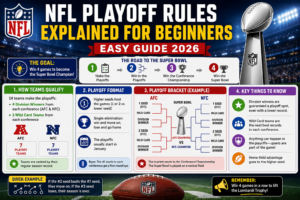
What Are the NFL Playoffs?
The NFL season has two main parts. The first part is the regular season. This is when all 32 teams play 17 games each, from September to early January. Teams try to win as many games as possible during this time.
After the regular season ends, the best teams move on to the second part of the season: the playoffs. This is sometimes called the “postseason.” The playoffs are a smaller, more intense competition. Only the top teams get to play, and every single game matters a lot more than a regular season game.
The playoffs end with one final game called the Super Bowl, where the last two remaining teams play each other to decide the champion of the entire NFL season.
Why the Playoffs Feel Different From the Regular Season
During the regular season, a team can lose a game and still have plenty of chances to bounce back. There are 17 games, so one bad week doesn’t end a team’s season.
The playoffs work in a completely different way. The NFL playoffs use what’s called a single-elimination format. This simply means: if your team loses one game, your season is over. There is no next week. There is no “we’ll get them next time.” One loss, and the team goes home for the year.
This is why playoff games are so exciting to watch. Every single play matters. A missed field goal, a fumble, or one bad decision can end a team’s entire season in an instant. This pressure is part of what makes the NFL playoffs so popular with fans.
How Many Teams Make the Playoffs?
Out of the 32 teams in the NFL, only 14 teams make it to the playoffs. That’s less than half the league.
The NFL is split into two conferences:
- The AFC (American Football Conference)
- The NFC (National Football Conference)
Each conference sends 7 teams to the playoffs. So 7 teams from the AFC plus 7 teams from the NFC equals 14 teams total.
Each conference is also split into four smaller groups called divisions. There are four divisions in the AFC and four divisions in the NFC. Each division has four teams in it.
Here’s how those 7 playoff spots per conference are filled:
- 4 division winners — the team with the best record in each of the four divisions automatically makes the playoffs, even if their record isn’t amazing compared to other teams in the league.
- 3 wild card teams — these are the three teams with the next-best records in the conference, even though they didn’t win their own division.
So in total, that’s 4 division winners plus 3 wild card teams, which equals 7 teams per conference, and 14 teams overall.
Wait, Does a Division Winner Always Make the Playoffs?
Yes. This is one of the more surprising rules for beginners. Even if a division winner has a losing record (meaning they lost more games than they won), they still make the playoffs as long as they finished first in their division. Division winners automatically qualify for the playoffs regardless of record, and if every team in a division finishes below .500, the division winner with the best record still qualifies as a playoff team.
This has actually happened a few times in NFL history, where a weak division still sends its top team to the playoffs. It might not feel fair, but it’s the rule, and it rewards teams for beating the other teams in their own division throughout the season.
What Is “Seeding” in the NFL Playoffs?
Once the 14 playoff teams are known, each conference lines up its 7 teams in order from best to worst. This order is called seeding. The teams are given a number from 1 to 7.
- Seed 1 is the best team in the conference.
- Seed 7 is the lowest-ranked team that still made the playoffs.
Seeding matters a lot because it decides two big things:
- Who plays who in each round
- Who gets to play at home, which is a big advantage
In general, home teams have an easier time because they get support from their own fans, they don’t have to travel, and they already know their stadium and weather conditions well. So having a high seed (like 1 or 2) is very valuable.
How Is the Seeding Order Decided?
Seeding is based on regular season win-loss records. The team with the best record in the conference usually gets seed 1, and so on down the line. If two or more teams have the exact same record, the NFL uses a list of tiebreaker rules — things like who won when those two teams played each other, or who had a better record within their own division — to decide who gets the higher seed.
You don’t need to memorize every tiebreaker rule. Just remember the basic idea: better regular season performance equals a better seed, and a better seed usually equals an easier and safer path through the playoffs.
The Four Rounds of the NFL Playoffs
The playoffs consist of four rounds: Wild Card Weekend, the Divisional Round, the Conference Championship Games, and the Super Bowl, with each round cutting the number of remaining teams in half. Let’s go through each one so you understand exactly what happens at every stage.
Round 1: Wild Card Weekend
This is the very first round of the playoffs, and it’s where most of the 14 teams begin their journey.
Here’s an important detail: even though 14 teams make the playoffs, not all 14 play in the first round. Only the lowest 12 seeded teams actually play during Wild Card Weekend. That’s because the very best team in each conference (seed number 1) gets something special: a bye week.
What is a bye?
A “bye” simply means that team does not have to play during Wild Card Weekend. They automatically move on to the next round while everyone else is fighting for their playoff lives. This is one of the biggest rewards in the NFL playoffs. Getting a bye gives the top team extra rest, extra time to heal from injuries, and extra time to prepare for whoever they’ll face next.
Who plays who in the Wild Card round?
Since seed 1 sits out, the remaining six seeds in each conference (seeds 2 through 7) are matched up like this:
- Seed 2 hosts Seed 7
- Seed 3 hosts Seed 6
- Or 4 hosts Seed 5
This means the higher seed always plays at home against the lower seed. So in each conference, there are three Wild Card games, and with two conferences, that makes six Wild Card games total across the whole league.
The winners of these games move on. The losers are eliminated and their season ends.
Round 2: The Divisional Round
Now things get more interesting. After Wild Card Weekend, each conference has four teams left: the seed 1 team that had the bye, plus the three winners from the Wild Card games.
In the Divisional Round, the matchups are set using a rule that’s easy to remember: the highest remaining seed plays the lowest remaining seed. In the divisional round of the NFL Playoffs, the No. 1 overall seed will host the lowest remaining seed.
For example, since seed 1 already had a bye and is guaranteed to still be in the mix, seed 1 will now face whichever remaining team has the lowest seed number left in the bracket. Meanwhile, the other two remaining teams play each other.
This is different from many other sports, where the playoff bracket is fixed from the very start. In the NFL, the matchups can shift depending on which lower seeds manage to win their Wild Card games. This is sometimes called re-seeding, and it’s a rule that beginners often find surprising.
There are two Divisional Round games per conference, so four games total across the league. After this round, only two teams remain in each conference.
Round 3: The Conference Championship Games
This is where things really heat up. With only four NFL teams remaining and two games to play, Conference Championship weekend is all about matching up the best with the best, as the two remaining playoff teams from the NFC and the two remaining teams in the AFC each meet in a single game.
So there are only two games during this round:
- The AFC Championship Game — the two remaining AFC teams play each other.
- The NFC Championship Game — the two remaining NFC teams play each other.
Just like earlier rounds, the higher remaining seed hosts the game. In the championship round, the highest remaining seed will host the lowest remaining seed.
Whoever wins the AFC Championship Game becomes the AFC representative in the Super Bowl. Whoever wins the NFC Championship Game becomes the NFC representative. These two winners will now face off in the biggest game of the year.
Round 4: The Super Bowl
This is the final game of the NFL season, and it’s one of the most-watched sporting events in the entire world. It’s simply the AFC Champion versus the NFC Champion, winner takes all.
There’s a fun and unusual rule about the Super Bowl that beginners often don’t know: unlike every other playoff game, the home team in the Super Bowl is not decided by seeding or record at all. Instead, it depends on whether the Super Bowl has an even or odd number that year. The AFC is treated as the home team in even-numbered Super Bowl games while the NFC is treated as the home team in odd-numbered games.
Also, the Super Bowl is typically played at a location that was chosen years in advance, often a stadium that doesn’t even belong to either team playing in the game. So in a way, neither team truly gets a “home crowd,” even though the schedule still labels one side as the official home team.
Whichever team wins the Super Bowl is crowned the champion of the entire NFL season.
What Happens if a Playoff Game Is Tied?
In the regular season, NFL games are allowed to end in a tie if the score is still even after overtime. But in the playoffs, a tie is simply not allowed. Someone has to win.
Unlike the league’s regular season games, playoff games cannot end in a tie, so any matchup that is tied after regulation goes to as many 15-minute overtime periods as necessary until a winner is decided.
This means if the score is even after the normal 60 minutes of football, the teams keep playing extra 15-minute periods, over and over if needed, until one team finally comes out ahead.
How Does Playoff Overtime Work?
The overtime rule used to be simpler and, some fans felt, unfair. In the old rule, whichever team got the ball first in overtime could just score a touchdown and win instantly, without the other team even getting a chance to touch the ball.
The NFL changed this because it felt unbalanced. Under the current rule, both teams are guaranteed one possession in overtime, no matter whether the team that gets the ball first manages to score. In simple words: both teams get a fair turn with the ball, at least once.
Here’s how it plays out in easy steps:
- A coin toss decides which team gets the ball first in overtime.
- That team gets a possession (a turn on offense) to try to score.
- If that team scores a touchdown, the other team still gets its own turn with the ball. The game isn’t over yet.
- If both teams have now had a possession and the score is still tied, the game moves into sudden death, meaning the very next team to score in any way wins the game immediately.
So the short version is: everyone gets at least one fair chance, and after that, the next score wins. No ties are allowed, so this process repeats with additional overtime periods until someone finally wins.
Why Home Field Advantage Matters So Much
You’ll notice that in almost every single playoff round, the better-seeded team gets to host the game. This is called home field advantage, and it’s a huge deal in the NFL playoffs.
Here’s why it matters:
- No travel fatigue – The home team doesn’t have to fly anywhere or adjust to a new time zone.
- Comfortable environment – Players are used to their own field, locker room, and weather conditions.
- Crowd noise – A loud home crowd can make it hard for the visiting team’s offense to communicate and hear the quarterback’s calls.
- Weather familiarity – Some stadiums have extreme conditions like cold, wind, or snow. Home teams are used to playing in that environment, while visiting teams often aren’t.
This is exactly why winning your division, and finishing with a strong regular season record, is so valuable. It’s not just about making the playoffs — it’s about giving your team the best possible chance once you’re there.
Common Playoff Terms for Beginners
Since football has its own vocabulary, here’s a simple list of terms you’ll often hear during the playoffs, explained in easy words:
- Bye week – When a team skips a playoff round and moves straight to the next one without playing.
- Wild card – A team that made the playoffs without winning its division, based on having one of the next-best records in the conference.
- Seed – A number (1 through 7) given to each playoff team based on how good their regular season record was compared to the rest of their conference.
- Single-elimination – A format where losing even one game ends your season immediately.
- Re-seeding – The process of updating who plays who in the next round, based on which seeds actually won and are still left in the bracket.
- Conference Championship – The round right before the Super Bowl, where only two teams remain in each conference.
- Sudden death – A phase of overtime where the very next team to score wins the game instantly.
Keeping these simple definitions in mind will help everything else about the playoffs make a lot more sense.
A Simple Step-by-Step Recap
If all of this still feels like a lot, here’s the entire playoff journey broken down into the simplest possible steps:
- The regular season ends, and the top 7 teams in each conference (14 total) qualify for the playoffs.
- Teams are ranked 1 through 7 in each conference based on their record. This ranking is called seeding.
- The number 1 seed in each conference gets a bye and skips the first round.
- The other six teams in each conference play three Wild Card games. Higher seeds host lower seeds.
- The winners move to the Divisional Round, where the highest remaining seed plays the lowest remaining seed.
- The two winners from each conference’s Divisional Round play each other in the Conference Championship Game.
- The winner of the AFC Championship and the winner of the NFC Championship meet in the Super Bowl.
- If any game is tied after regulation, it goes to overtime, where both teams are guaranteed a possession before it becomes sudden death.
- Whoever wins the Super Bowl is the NFL champion for that season.
That’s really the whole system in a nutshell.
Final Thoughts
The NFL playoffs might seem complicated at first, especially with all the talk of seeding, wild cards, and byes. But once you understand the basic building blocks — how teams qualify, how they’re ranked, how the bracket adjusts after each round, and what happens in overtime — it actually becomes pretty easy to follow.
The core idea to remember is simple: win your games, and you keep playing. Lose one, and your season ends. Add in the reward of home field advantage for better teams, and a fair, exciting overtime system, and you’ve got the recipe for one of the most thrilling postseasons in all of sports.
Now that you understand the NFL playoff rules, you can sit back, watch the games, and actually understand why certain teams have an advantage, why a “bye” is such a big deal, and what’s really at stake every time a team steps onto the field in January.