Competitive sports have evolved far beyond the days when a stopwatch and a coach’s gut feeling determined an athlete’s readiness for competition. Today, performance evaluation is a science unto itself, blending physiology, biomechanics, psychology, and data analytics into a comprehensive framework that helps athletes, coaches, and sports scientists understand exactly where an athlete stands — and where they can improve. Whether it’s a sprinter shaving milliseconds off a 100-meter dash, a basketball team optimizing shot selection, or a swimmer refining stroke mechanics, performance evaluation techniques form the backbone of modern athletic development.
Why Performance Evaluation Matters in Competitive Sports
Before diving into specific techniques, it’s worth understanding why performance evaluation has become such a critical pillar of athletic success. At the elite level, the margins between winning and losing are razor-thin. A fraction of a second, a slightly improved vertical leap, or a marginally better decision-making process under pressure can be the difference between a gold medal and fourth place.
Performance evaluation serves several essential purposes:
- Identifying strengths and weaknesses — Athletes and coaches gain objective insight into what’s working and what needs improvement.
- Reducing injury risk — Monitoring load, fatigue, and biomechanics helps prevent overtraining and injury.
- Personalizing training programs — Data-driven insights allow for individualized training rather than one-size-fits-all approaches.
- Tracking progress over time — Consistent evaluation creates benchmarks that show whether an athlete is improving, plateauing, or regressing.
- Informing tactical and strategic decisions — In team sports, performance data shapes game plans, substitutions, and opponent scouting.
- Supporting talent identification — Evaluation techniques help scouts and academies identify promising athletes early.
With these goals in mind, let’s explore the techniques that make this possible.
1. Physical Fitness Testing
Physical fitness testing remains one of the most foundational performance evaluation techniques in competitive sports. These tests assess an athlete’s baseline physical capabilities and are often repeated periodically to track progress.
Aerobic Capacity Testing (VO2 Max)
VO2 max — the maximum rate at which the body can consume oxygen during intense exercise — is a gold-standard measure of cardiovascular fitness. Endurance athletes such as long-distance runners, cyclists, and swimmers rely heavily on VO2 max testing to gauge aerobic capacity. Testing typically involves a graded exercise test on a treadmill or stationary bike, with the athlete wearing a mask connected to a metabolic cart that measures oxygen consumption and carbon dioxide output.
Anaerobic Power and Capacity Testing
For sports that demand explosive, short-duration efforts — such as sprinting, weightlifting, or football — anaerobic testing is more relevant. The Wingate Anaerobic Test, for example, measures peak power output and fatigue index over a 30-second maximal cycling effort.
Strength Testing
One-repetition maximum (1RM) testing for exercises like the squat, bench press, and deadlift remains a standard way to assess maximal strength. Isokinetic dynamometry, which measures force output at a constant velocity, offers a more nuanced view of strength imbalances between limbs or muscle groups — critical for injury prevention.
Flexibility and Mobility Testing
Range of motion assessments, such as the sit-and-reach test or goniometric measurements of joint angles, help identify mobility restrictions that could limit performance or increase injury risk.
Speed and Agility Testing
Sprint tests (10m, 20m, 40m dashes), the T-test, and the 5-10-5 pro agility shuttle are commonly used to evaluate acceleration, top-end speed, and change-of-direction ability — all crucial in sports like soccer, football, and basketball.
2. Biomechanical Analysis
Biomechanics examines the mechanical aspects of human movement, and it has become indispensable in performance evaluation. By analyzing how an athlete moves, coaches can identify inefficiencies, asymmetries, or technical flaws that limit performance or predispose the athlete to injury.
Motion Capture Technology
3D motion capture systems, using reflective markers and multiple high-speed cameras, allow sports scientists to break down movement into precise kinematic data — joint angles, velocities, and accelerations. This technology is widely used in sports like golf (swing analysis), baseball (pitching mechanics), and sprinting (stride analysis).
Force Plates
Force plates measure the ground reaction forces an athlete generates during movements like jumping, landing, or sprinting starts. This data reveals asymmetries between limbs, power output, and landing mechanics — all valuable for both performance enhancement and injury prevention, particularly for anterior cruciate ligament (ACL) injury risk assessment.
Video Analysis Software
While not as precise as full motion capture, video analysis tools like Dartfish, Hudl, or Kinovea allow coaches to break down technique frame-by-frame using standard video footage. This is a more accessible and affordable option for teams and athletes at all levels, from youth sports to professional franchises.
3. Wearable Technology and Sensor-Based Monitoring
Perhaps no development has transformed performance evaluation more than the rise of wearable technology. These devices provide continuous, real-time data on an athlete’s physiological and biomechanical state — helping coaches make informed decisions on training load, recovery, and readiness.
GPS and Accelerometer Tracking
GPS units, often worn in a vest between the shoulder blades, track distance covered, sprint speed, acceleration/deceleration counts, and player load during training and competition. This is especially valuable in field sports like soccer, rugby, and American football, where understanding an athlete’s work rate and positioning helps optimize both performance and recovery.
Heart Rate Monitoring
Heart rate variability (HRV) and resting heart rate tracking offer insight into an athlete’s autonomic nervous system status, which reflects recovery and readiness to train. A declining HRV trend, for example, may signal accumulated fatigue or overtraining risk.
Inertial Measurement Units (IMUs)
Small, wearable IMUs — combining accelerometers, gyroscopes, and sometimes magnetometers — can be attached to specific body segments to analyze movement patterns outside a lab setting. These are increasingly used in sports like cricket (bowling mechanics), boxing (punch force and speed), and rowing (stroke technique).
Sleep and Recovery Trackers
Devices like WHOOP, Oura Ring, and Garmin trackers monitor sleep quality, recovery scores, and strain, giving athletes and coaches a holistic picture of how well the body is recovering between sessions — a crucial but often overlooked component of performance evaluation.
4. Performance Analytics and Statistical Modeling
In many sports, especially those with rich datasets like basketball, baseball, and soccer, statistical analysis has become central to performance evaluation.
Advanced Metrics and Sabermetrics
Baseball pioneered the use of advanced statistics — often called sabermetrics — to evaluate sports player performance beyond traditional counting stats like batting average or RBIs. Metrics such as Wins Above Replacement (WAR), on-base plus slugging (OPS), and exit velocity provide a more nuanced understanding of a player’s contribution to winning.
Basketball has similarly embraced advanced metrics like Player Efficiency Rating (PER), true shooting percentage, and win shares, while soccer analysts use expected goals (xG) and expected assists (xA) to evaluate the quality of scoring chances created or converted, independent of finishing luck.
Predictive Modeling and Machine Learning
Teams increasingly use machine learning models to predict performance outcomes, injury risk, and even opponent tendencies. These models ingest vast datasets — from historical performance to biomechanical data — to generate insights that would be impossible to detect through traditional observation alone.
Notational and Match Analysis
Notational analysis involves systematically recording specific events during competition — passes, tackles, shots, turnovers — to quantify performance patterns. Software like Opta, StatsBomb, and Sportscode allows analysts to tag and review these events, generating heat maps, pass networks, and other visualizations that inform tactical decisions.
5. Psychological and Cognitive Evaluation
Physical prowess alone doesn’t determine competitive success. Mental toughness, focus, decision-making under pressure, and emotional regulation all play crucial roles — which is why psychological evaluation has become an increasingly important part of comprehensive performance assessment.
Psychometric Testing
Standardized questionnaires and psychometric tools assess traits like resilience, anxiety, motivation, and confidence. Tools such as the Sport Anxiety Scale or the Athletic Coping Skills Inventory help sports psychologists identify areas where mental skills training could benefit an athlete.
Reaction Time and Cognitive Testing
Reaction time tests measure how quickly an athlete processes information and responds — critical in sports requiring split-second decisions, like tennis, boxing, or goalkeeping. Cognitive testing platforms can also assess attention, working memory, and decision-making speed under simulated pressure conditions.
Neurofeedback and EEG Monitoring
Some elite programs use electroencephalography (EEG) and neurofeedback training to help athletes achieve optimal mental states — such as the “flow state” — during competition. While still a niche application, this technology is gaining traction in sports like archery, shooting, and golf, where mental composure is paramount.
6. Physiological Monitoring and Biomarker Analysis
Beyond wearable tech, deeper physiological assessments provide insight into an athlete’s internal state and adaptation to training.
Blood and Saliva Biomarkers
Regular blood testing can track markers like creatine kinase (indicating muscle damage), cortisol (stress hormone levels), testosterone-to-cortisol ratio (an indicator of training adaptation), and hemoglobin/ferritin levels (relevant to endurance athletes at risk of anemia). Saliva testing offers a less invasive alternative for tracking some of these same markers.
Lactate Threshold Testing
Lactate threshold testing determines the exercise intensity at which lactate begins to accumulate in the blood faster than it can be cleared. This is a critical metric for endurance athletes, helping to define training zones for optimal aerobic and anaerobic development.
Body Composition Analysis
Techniques like dual-energy X-ray absorptiometry (DEXA) scans, bioelectrical impedance analysis, and skinfold measurements assess body fat percentage and lean muscle mass. This information helps optimize training and nutrition strategies, particularly in weight-class sports or aesthetic sports like gymnastics and diving.
7. Skill-Specific Technical Assessments
While general fitness and physiological testing provide a broad picture, sport-specific technical assessments zero in on the precise skills that determine competitive success in a given discipline.
Examples include:
- Basketball: Shooting percentage under fatigue, free-throw consistency, dribbling under pressure drills.
- Soccer: Passing accuracy under time constraints, first-touch control assessments, small-sided game performance.
- Tennis: Serve speed and accuracy, rally consistency, movement efficiency on court.
- Swimming: Stroke count per length, turn efficiency, underwater dolphin kick speed.
- Track and Field: Split times, stride length and frequency, reaction time off the blocks.
These sport-specific assessments are often combined with video and biomechanical analysis for a complete technical profile.
8. Game and Match Performance Review
For team sports in particular, post-competition review is an essential evaluation technique. Coaches and analysts break down game footage to assess individual and team performance against tactical objectives.
Film Study and Tagging
Coaches review game film, often using specialized software to tag key events and generate statistical summaries. This allows for objective feedback rather than relying solely on subjective impressions from the sideline.
Player Tracking Data
In leagues with advanced tracking systems — such as the NBA’s Second Spectrum or the Premier League’s optical tracking cameras — every player’s movement on the field or court is recorded multiple times per second. This generates rich datasets on positioning, spacing, and off-ball movement that go far beyond what’s visible to the naked eye.
Opponent Scouting
Performance evaluation isn’t limited to self-assessment. Understanding an opponent’s tendencies, strengths, and weaknesses through systematic video and statistical analysis is equally important for competitive preparation.
9. Load Management and Injury Risk Assessment
Modern performance evaluation places significant emphasis on managing training load to optimize performance while minimizing injury risk.
Acute-to-Chronic Workload Ratio (ACWR)
This metric compares an athlete’s recent training load (acute, typically over the past week) to their longer-term average load (chronic, typically over the past four weeks). A significant spike in this ratio has been associated with increased injury risk, making it a valuable monitoring tool for sports scientists.
Rate of Perceived Exertion (RPE)
A simple but effective tool, RPE asks athletes to subjectively rate the intensity of a training session on a numerical scale (commonly 1–10). When combined with session duration, this generates a “session-RPE” load metric that, while less precise than objective physiological data, is inexpensive and easy to implement across all levels of competition.
Movement Screening
Screens like the Functional Movement Screen (FMS) assess fundamental movement patterns to identify asymmetries or limitations that could predispose an athlete to injury, informing corrective exercise programs.
10. Benchmarking and Longitudinal Tracking
Perhaps the most important aspect of any performance evaluation system is consistency over time. A single test provides only a snapshot; the real value comes from longitudinal tracking that reveals trends, adaptations, and the effectiveness of training interventions.
Establishing normative data — whether based on an athlete’s own historical performance or benchmarks against peers at a similar competitive level — allows coaches to contextualize results. A vertical jump of 30 inches, for instance, means little in isolation, but becomes meaningful when compared to an athlete’s previous testing sessions or to positional benchmarks within their sport.
Best practices for longitudinal tracking include:
- Testing under standardized, repeatable conditions (same time of day, similar fatigue state, consistent equipment).
- Using integrated athlete management systems that consolidate data from multiple sources (wearables, testing sessions, subjective wellness questionnaires) into a single dashboard.
- Setting realistic, periodized benchmarks aligned with the competitive calendar, rather than expecting linear improvement year-round.
Integrating Performance Evaluation into a Cohesive System
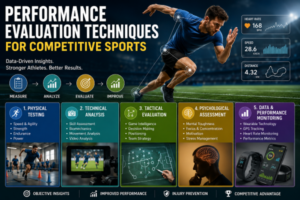
No single technique tells the whole story. The most effective performance evaluation programs integrate multiple data streams — physical testing, biomechanical analysis, wearable data, psychological assessment, and match statistics — into a cohesive, athlete-centered system. This holistic approach allows coaches and sports scientists to triangulate findings, cross-validate insights, and make more confident decisions about training design, competition readiness, and injury prevention.
Increasingly, sports organizations employ dedicated performance analysts or sports science departments whose sole responsibility is managing this integration — collecting data, interpreting it in context, and translating it into actionable recommendations for coaches and athletes. The rise of centralized athlete management systems (AMS) has made this integration more feasible, even for programs with limited resources.
Challenges and Considerations
Despite the sophistication of modern performance evaluation techniques, several challenges remain worth acknowledging:
- Data overload: With so many available metrics, there’s a real risk of collecting more data than can be meaningfully interpreted or acted upon. Effective programs prioritize a focused set of key performance indicators relevant to the specific sport and athlete.
- Cost and accessibility: Many advanced technologies — motion capture systems, DEXA scans, GPS tracking — remain expensive, limiting access primarily to well-funded professional or collegiate programs. Grassroots and youth sports often rely on more accessible, low-cost alternatives.
- Individual variability: Athletes respond differently to training stimuli, and normative benchmarks don’t always account for individual differences in genetics, training history, or recovery capacity.
- Balancing quantitative and qualitative insight: While data provides objectivity, the experienced eye of a coach remains invaluable for interpreting context that numbers alone can’t capture.
The Future of Performance Evaluation in Sports
Looking ahead, several trends are shaping the next generation of performance evaluation:
- Artificial intelligence and machine learning are increasingly used to identify patterns in complex datasets that would be impossible for humans to detect manually, from predicting injury risk to optimizing individualized training loads.
- Wearable sensor miniaturization continues to improve, allowing for more unobtrusive, continuous monitoring without hindering athletic movement.
- Real-time feedback systems are emerging that provide athletes with instant biomechanical or physiological feedback during training, accelerating the learning process.
- Democratization of technology is gradually making advanced evaluation tools more affordable and accessible to amateur and youth athletes, not just elite professionals.
Case Studies: Performance Evaluation in Action
To understand how these techniques translate into real-world results, it helps to look at how different sports have applied them in practice.
Case Study 1: Endurance Running
Elite distance running programs often combine lactate threshold testing, VO2 max assessments, and GPS-based training load monitoring to fine-tune an athlete’s training zones. A runner who discovers their lactate threshold occurs at a lower percentage of VO2 max than expected might shift training emphasis toward tempo runs and threshold work rather than pure high-intensity interval sessions. Over a training cycle, repeated testing reveals whether these adjustments are producing the desired physiological adaptations, allowing coaches to fine-tune the program in near real time rather than waiting until race day to find out whether the plan worked.
Case Study 2: Professional Soccer
Top-tier soccer clubs typically layer GPS tracking, heart rate monitoring, and notational match analysis to build a complete picture of player workload and tactical contribution. A winger who covers unusually high sprint distances in training but shows declining high-speed running output during matches might be flagged for fatigue management, with coaching staff adjusting minutes played or recovery protocols accordingly. Meanwhile, expected goals (xG) data helps technical staff evaluate whether a striker’s finishing is underperforming or overperforming relative to the quality of chances created — informing decisions about playing style and recruitment.
Case Study 3: Olympic Weightlifting
In strength sports, performance evaluation centers heavily on force plate analysis and velocity-based training. By measuring bar speed during lifts, coaches can determine whether an athlete is training in the optimal zone for strength, power, or speed-strength development. Combined with periodic 1RM testing and movement screening to catch technical breakdowns before they cause injury, this data-driven approach allows for highly individualized programming that maximizes gains while minimizing the risk of overtraining.
Case Study 4: Youth and Grassroots Sports
Not every program has access to force plates or motion capture labs, and that’s perfectly fine. Youth coaches can still apply meaningful evaluation techniques using low-cost tools: stopwatch-based sprint tests, simple RPE scales for monitoring training load, video recorded on a smartphone for basic technique review, and standardized fitness circuits like the beep test. The principles of consistent testing, benchmarking, and longitudinal tracking apply just as much at the grassroots level as they do in professional sport — only the sophistication of the tools changes.
Building a Performance Evaluation Plan: Practical Steps
For coaches, athletes, or sports organizations looking to implement a more structured approach to performance evaluation, the following steps provide a practical starting point:
- Define clear objectives: Determine what you’re trying to measure and why. Evaluation for its own sake wastes time and resources; every test should connect to a specific decision it will inform.
- Select appropriate tools for your context: Match the sophistication of your evaluation techniques to your budget, staffing, and competitive level. A high school team doesn’t need a DEXA scanner to benefit from structured fitness testing.
- Standardize testing protocols: Consistency in timing, conditions, and procedures is essential for data to be meaningful over time.
- Establish a testing calendar: Align evaluation sessions with the training periodization plan — for example, baseline testing at the start of a preseason, monitoring testing throughout the competitive season, and comprehensive testing during the off-season.
- Interpret data in context: Numbers alone don’t tell the full story. Combine quantitative results with coach observation, athlete feedback, and competition outcomes to form a complete picture.
- Communicate findings clearly: Athletes are more likely to buy into training adjustments when they understand what the data shows and why changes are being made.
- Review and adjust: Treat the evaluation system itself as something to be refined over time, adding or removing tests based on what proves genuinely useful.
Frequently Asked Questions
How often should performance evaluation testing be conducted? This depends on the sport, the specific metric, and the athlete’s competitive calendar. Some measures, like resting heart rate or subjective wellness, can be tracked daily. Others, like VO2 max or 1RM strength testing, are typically assessed every four to eight weeks, or at key points in a periodized training plan such as the start and end of a training block.
Do amateur athletes need the same evaluation techniques as professionals? Not necessarily. While the underlying principles of consistent, objective evaluation apply at every level, amateur athletes can benefit significantly from simpler, more accessible tools. What matters most is regularity and consistency, not access to the most advanced technology available.
Can performance evaluation help prevent injuries? Yes. Techniques like movement screening, load monitoring, and biomechanical analysis are specifically designed to flag early warning signs — asymmetries, workload spikes, or technical breakdowns — before they progress into injuries. However, no evaluation system can eliminate injury risk entirely, since sport inherently involves physical risk.
What’s the biggest mistake teams make with performance evaluation? Collecting data without a clear plan for how it will be used. Many programs invest heavily in testing and technology but fail to build the analytical and communication processes needed to translate data into actionable coaching decisions.
Conclusion
Performance evaluate sports in competitive sports has transformed from a subjective, observation-based practice into a multidimensional science that draws on physiology, biomechanics, psychology, and data analytics. From VO2 max testing and force plate analysis to wearable GPS trackers and machine learning-driven predictive models, today’s athletes and coaches have access to an unprecedented array of tools to understand and enhance performance.
Ultimately, the value of these techniques lies not in the sophistication of any single test, but in how thoughtfully they’re integrated into a coherent system that serves the athlete’s development. When physical, technical, psychological, and tactical evaluation work together, they create a comprehensive picture that empowers athletes to reach their full competitive potential — while also protecting their long-term health and career longevity.