If you’ve ever tried to plan a weekend around watching your favorite team, only to discover their season just ended (or hasn’t started yet), you already know how confusing the world of sports seasons can be. Unlike the neat, predictable rhythm of the calendar year, the sports world runs on dozens of overlapping timelines, each shaped by history, climate, television contracts, and the physical demands of the game itself. Understanding this rhythm isn’t just useful trivia — it’s the key to never missing a big game, planning a smarter fantasy sports draft, or simply making sense of why your group chat is obsessed with a different sport every few months.
This guide breaks down everything you need to know about sports seasons, the broader sports calendar, and how to think about sports schedule planning across the world’s biggest sports leagues. Whether you’re a casual fan trying to figure out what sports are in season right now, or someone looking to build a year-round habit of sports activities, this article will give you a clear, practical map of the sporting year.
Table of Contents
- Why Sports Have Seasons in the First Place
- The Four Seasons of Sport: A Framework for Understanding the Calendar
- Fall Sports: The Return of Football and the Start of Winter Leagues
- Winter Sports: Basketball, Hockey, and the Cold-Weather Calendar
- Spring Sports: Baseball, March Madness, and the Awakening of Outdoor Sports
- Summer Sports: The Season of Everything
- Major American Sports Leagues and Their Seasonal Windows
- Global Sports Leagues and How Their Calendars Differ
- Individual and Olympic-Style Sports: A Different Kind of Season
- College and School Sports Seasons
- How Weather, Geography, and Culture Shape the Sports Calendar
- Why Some Sports Overlap and Why That Matters
- Building Your Own Personal Sports Calendar
- The Off-Season: What Actually Happens When a League Isn’t Playing
- Sports Seasons and Fantasy Sports Planning
- Tips for Staying on Top of the Sports Schedule Year-Round
- Final Thoughts: Making the Most of Every Sports Season
1. Why Sports Have Seasons in the First Place
Before diving into the specifics, it’s worth asking a simple question: why do sports have seasons at all? Why isn’t there just one enormous, continuous calendar of sports events running nonstop, 365 days a year?
The answer comes down to a mix of practical, biological, and commercial factors.
- Physical recovery: Athletes are not machines. A sports season that runs too long without a break increases injury risk dramatically. Leagues build in off-seasons specifically so players can rest, rehabilitate, and train for the next cycle. This is one of the most underrated reasons the modern sports calendar looks the way it does — it’s a compromise between fan demand for constant content and the very real limits of the human body.
- Weather and climate: Many sports are tied directly to the seasons of the natural year. Skiing needs snow. Baseball needs dry, temperate fields. Outdoor tennis and golf are far more enjoyable — and safer — in mild weather.
- Television and media rights: Modern professional sports are built on enormous broadcasting deals. Networks don’t want every major sports league competing for the same eyeballs on the same nights. Scheduling is often negotiated so that football, basketball, baseball, and hockey seasons overlap just enough to keep fans engaged year-round, but not so much that they cannibalize each other’s audiences.
- Tradition and history: Some seasonal patterns exist simply because “that’s how it’s always been.” Baseball’s spring-to-fall rhythm dates back over a century, tied to agrarian schedules and the availability of daylight before stadium lighting existed.
Understanding these underlying forces makes the rest of the sports calendar much easier to decode, because you start to see the why behind every date on the schedule, not just the what.
2. The Four Seasons of Sport: A Framework for Understanding the Calendar
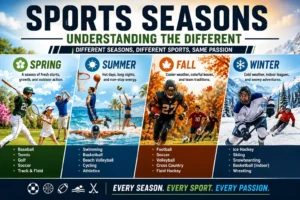
One of the simplest ways to make sense of sports seasons is to map them onto the four seasons of the year. This isn’t a perfect system — plenty of leagues span multiple seasons, and some sports genuinely never stop — but it’s a useful mental model for beginners trying to figure out what sports are in season at any given time.
- Fall (September–November): The transition season. Football (American and international), ice hockey, and basketball all begin. Baseball wraps up with its postseason.
- Winter (December–February): The heart of the indoor season. Basketball and hockey are in full swing, football playoffs dominate headlines, and winter sports like skiing and snowboarding take center stage.
- Spring (March–May): A season of renewal. Baseball starts fresh, basketball and hockey playoffs unfold, and outdoor sports like tennis, golf, and track and field begin their major events.
- Summer (June–August): The most crowded season of all. Baseball is in full stride, soccer leagues around the world often pause (while international tournaments take over), and a huge range of outdoor sports activities — from swimming to cycling to athletics — hit their peak.
This four-part framework is the backbone of the rest of this guide. Once you understand which sports “belong” to which stretch of the year, the entire sports schedule starts to feel far less chaotic and far more like a rhythm you can plan your life around.
3. Fall Sports: The Return of Football and the Start of Winter Leagues
For many sports fans, autumn feels like the true “New Year” of the sporting calendar. This is when American football dominates the conversation, both at the professional and college level. The season typically kicks off in late August or early September and runs into early winter, with the postseason stretching into January and the championship game held in early February.
Fall is also when several other major sports leagues begin their long winter campaigns:
- Basketball (professional and college) tips off in October, beginning a season that will stretch all the way into the following June.
- Ice hockey also starts its regular season in October, running deep into the spring.
- Soccer leagues in Europe and much of the world are in the thick of their fall stretch, having started in August and continuing through the winter with only a short holiday break.
- Baseball is winding down in the fall, with its championship series typically played in October — meaning for a few golden weeks, fall fans get overlapping baseball postseason drama alongside the start of football, basketball, and hockey.
This overlap is one of the busiest stretches on the entire sports calendar. If you’re trying to follow multiple leagues at once, September and October are demanding months — but also some of the most exciting, since you get the climax of one sports season colliding with the launch of several others.
Fall is also prime time for sports activities tied to cooler weather: cross-country running, marathon season (many of the world’s biggest city marathons are held in September and October), and the start of collegiate sports like volleyball and soccer.
4. Winter Sports: Basketball, Hockey, and the Cold-Weather Calendar
By the time December arrives, football has entered its playoff push, but basketball and hockey are now the dominant storylines on the domestic sports schedule. Both leagues play extremely long regular seasons — often 80 or more games — which means winter is essentially the “grind” phase, where teams jockey for playoff positioning while fans watch nightly games roll by.
Winter is also home to sports that quite literally require cold weather and snow:
- Alpine and cross-country skiing
- Snowboarding
- Figure skating and speed skating
- Bobsled, luge, and skeleton
These winter-specific disciplines usually reach their peak visibility every four years during the Winter Olympics, but they maintain an active competitive circuit (World Cup tours, national championships) every single winter, even in non-Olympic years.
Football’s postseason is the other major storyline of this period. The playoffs stretch through January, culminating in the championship game in early February — arguably the single biggest annual sports event in the United States, and a moment where even casual fans tune into the sports calendar.
For fans who enjoy sports activities rather than just spectating, winter is also the season for recreational skiing, snowboarding, ice skating, and indoor sports like volleyball, wrestling, and swimming, many of which hold their collegiate championships in this window.
5. Spring Sports: Baseball, March Madness, and the Awakening of Outdoor Sports
Spring might be the single busiest transitional period in the entire sports calendar. It’s when:
- Baseball returns for a fresh season, typically starting in late March or early April and running all the way through the following October.
- Basketball’s regular season wraps up and its postseason tournament begins, capturing national attention with weeks of single-elimination drama.
- Hockey’s playoffs begin, an extended postseason famous for its unpredictability and physical intensity.
- Golf’s major championship season kicks into gear, with several of its biggest tournaments held in the spring months.
- Tennis shifts from hard courts to clay, building toward one of its four annual Grand Slam events.
- Track and field, rowing, and outdoor cycling all pick up as the weather warms.
- Soccer leagues around the world enter their final, most dramatic stretch, with championships, relegation battles, and continental club competitions reaching their climax.
Spring is a genuinely thrilling time to be a sports fan because so many storylines are converging at once — some leagues ending, others just beginning. It’s also a great time to explore sports activities yourself, since the weather is often ideal for running, cycling, hiking, and outdoor recreation.
6. Summer Sports: The Season of Everything
If fall is the “reset” of the sports calendar, summer is its climax. This is when the widest range of sports events happen simultaneously:
- Baseball is in full swing (literally), with its All-Star break serving as the traditional midpoint of the season.
- Tennis holds two of its four Grand Slam tournaments during the summer months.
- Golf continues its major championship rotation.
- Swimming, athletics, gymnastics, and dozens of other Olympic sports reach peak intensity, especially in years when the Summer Olympics are held.
- Cycling’s most famous multi-week road race takes place in midsummer.
- Most major soccer leagues are on their off-season break, but this is exactly when international soccer tournaments — World Cups, continental championships — are often scheduled, filling the gap left by domestic leagues.
- Cricket, especially in countries where it’s the dominant sport, runs major international tours and domestic tournaments through the summer months.
Summer is also the season most associated with recreational sports activities: youth sports leagues, community swim teams, beach volleyball, open-water swimming, triathlons, and casual pickup games. If you’re building healthy habits around sport rather than just spectating, summer offers the widest range of options simply because the weather cooperates almost everywhere.
7. Major American Sports Leagues and Their Seasonal Windows
To make this more concrete, here’s a general overview of how the major professional sports leagues in North America structure their seasons. Exact dates shift slightly year to year, so always check the official league schedule for precise details, but the broad pattern has been remarkably consistent for decades.
- Football (professional): Preseason in August, regular season from early September through early January, playoffs through January, championship game in early February.
- Basketball (professional): Preseason in early October, regular season from October through April, playoffs from April through June. Basketball is the sport that most fully bridges fall, winter, and spring, making it one of the most reliable constants on the sports calendar.
- Baseball (professional): Spring training in February and March, regular season from late March/early April through late September, postseason through October.
- Ice hockey (professional): Preseason in September, regular season from October through April, playoffs from April through June. Hockey’s calendar closely mirrors basketball’s, which is part of why the two sports so often share headlines during their overlapping stretch.
- Soccer (Major League Soccer, North America): Regular season from February/March through October, playoffs in the fall. Notably, this is opposite to the pattern in much of Europe, where top-flight soccer runs from August through May — a distinction worth remembering if you follow both domestic and international sports leagues.
Recognizing this rhythm is the single most useful trick for understanding what sports are in season at any point in the year. Print it out, save it, or just remember the broad strokes: football owns the fall, basketball and hockey own the winter, baseball owns the summer, and spring is when nearly everything briefly overlaps.
8. Global Sports Leagues and How Their Calendars Differ
The sports calendar looks very different depending on where in the world you live, and it’s worth understanding these differences if you follow international sports.
European soccer is the clearest example. Nearly all of the continent’s major domestic leagues — in England, Spain, Italy, Germany, and France — run from August through May, with a short winter break in some countries and none at all in others. This is the opposite of the North American pattern, where most leagues avoid competing directly with football season in the fall.
Cricket has an even more complex calendar because it depends heavily on the country. In England and Australia, cricket seasons are tied closely to their respective summers (opposite halves of the year), while in South Asia, cricket is played nearly year-round, blending domestic tournaments, international tours, and globally televised league competitions.
Rugby varies by hemisphere and code. Northern Hemisphere rugby union leagues typically run from autumn through spring, while Southern Hemisphere competitions often align with their local summer and autumn months — meaning “rugby season” genuinely depends on which side of the equator you’re on.
Australian Rules Football and Aussie sports generally follow the Southern Hemisphere’s seasonal calendar, which is inverted from North America and Europe — their “summer sports” happen during what is winter in the Northern Hemisphere, and vice versa.
Formula 1 and international motorsport run a globe-spanning calendar from March through around December, hopping between hemispheres and climates specifically to avoid extreme weather in any single region.
This global variation is a great reminder that “the” sports calendar doesn’t really exist as a single universal thing — it’s really dozens of overlapping regional and cultural calendars, each shaped by local climate, tradition, and league structure.
9. Individual and Olympic-Style Sports: A Different Kind of Season
Not every sport fits neatly into a league structure with a clear start and end date. Many individual sports — tennis, golf, track and field, swimming, gymnastics, cycling — operate on a “tour” or “circuit” model instead.
Tennis is a good example: rather than one continuous season with a single champion, the sport crowns four separate Grand Slam champions across the calendar year (roughly January, May–June, June–July, and August–September), with dozens of smaller tournaments filling the gaps in between. In this sense, tennis has multiple “mini-seasons” packed into one long year-round tour.
Golf works similarly, with major championships spread across spring and summer, book-ended by a long stretch of regular tour events that essentially run nearly year-round.
Track and field, swimming, and gymnastics often follow a quieter rhythm most years, with domestic and international championships scattered through spring and summer, before exploding into mainstream attention every four years during the Summer Olympics.
Olympic sports more broadly are a special case in the sports calendar: many disciplines that get relatively modest attention in non-Olympic years become massive global sports events for a few weeks every four years, as the Summer and Winter Games alternate on a two-year offset.
Understanding this “tour” model versus the “league” model is important, because it explains why some sports feel like they’re always happening in the background of the sports schedule, rather than switching on and off like football or basketball.
10. College and School Sports Seasons
For many fans, especially in the United States, college and school sports follow their own distinct rhythm layered on top of the professional sports calendar. Broadly, school sports tend to mirror the academic year:
- Fall sports (September–November): football, soccer, cross-country, volleyball
- Winter sports (November–March): basketball, wrestling, swimming, ice hockey
- Spring sports (March–June): baseball, softball, track and field, tennis, golf, lacrose
This structure exists largely because school sports are built around student availability, academic calendars, and facility access — not television deals or professional playoff logistics. It also means that youth and school athletes are often exposed to an entirely different sport every few months, which is one of the reasons multi-sport participation is common (and often recommended) at the youth level.
If you have kids involved in school athletics, understanding this three-season structure is essential for planning family schedules, since it’s common for a household to be juggling completely different sports activities in fall, winter, and spring — sometimes even for the same child.
11. How Weather, Geography, and Culture Shape the Sports Calendar
It’s worth pausing to appreciate just how much of the sports calendar is really a response to weather and geography, even in sports that seem purely driven by tradition.
Outdoor sports like baseball, golf, and tennis are scheduled to avoid the harshest months of winter in temperate climates — hence baseball’s spring start and fall finish. Winter sports like skiing and hockey (originally an outdoor sport) are scheduled to take advantage of cold weather and, historically, natural ice.
Geography also explains why the same sport can have wildly different seasons depending on where it’s played. Soccer in Northern Europe runs from late summer through late spring specifically to avoid summer heat and to align with school and work calendars, while soccer in the Southern Hemisphere (Australia, parts of South America) sometimes follows the opposite pattern to fit local climate and cultural calendars.
Culture plays a role too. In many countries, the biggest sports leagues are scheduled around existing cultural and religious calendars, national holidays, and traditional festival seasons, meaning the “sports calendar” is often deeply intertwined with the broader cultural calendar of a region, not just a product of pure logistics.
12. Why Some Sports Overlap and Why That Matters
If you look at the sports calendar as a whole, one of the most striking features is just how much overlap exists. September through November is packed with football, the tail end of baseball, and the start of basketball and hockey. Spring is even busier, with basketball and hockey playoffs colliding with the start of baseball, the peak of the golf and tennis calendars, and the climax of most soccer leagues.
This overlap isn’t accidental — it reflects a few deliberate industry dynamics:
- Leagues want a share of fan attention year-round, so they intentionally schedule around, rather than directly on top of, each other’s marquee moments where possible.
- Media companies benefit from a packed calendar, since more simultaneous sports events means more programming inventory to sell to advertisers.
- Fans genuinely enjoy the overlap: For many people, the appeal of being a sports fan is precisely this rotating buffet of storylines — one league’s championship chase overlapping with another’s fresh start.
Understanding this overlap helps explain why certain months (like April, when basketball and hockey playoffs begin just as baseball gets underway) feel like the busiest stretches of the entire year for sports fans, while other months (like early August, wedged between the end of most leagues’ off-seasons and the start of football) feel comparatively quiet.
13. Building Your Own Personal Sports Calendar
Given how many overlapping sports seasons exist, one of the most practical things a fan can do is build a personal sports calendar — a simple, ongoing reference for which of your favorite sports leagues are active at any given time.
Here’s a simple approach:
- List your favorite sports and leagues: Be specific — “basketball” is too broad if you only care about one league or one team.
- Note the rough start and end dates for the regular season and postseason of each one, using official league sources for accuracy.
- Mark the key recurring sports events you never want to miss — opening day, championship weekends, major tournaments.
- Identify overlap periods where multiple favorites are active at once, so you can plan your free time accordingly.
- Note off-season periods for each league, so you’re not caught off guard when a sport suddenly disappears from the schedule for months.
This kind of personal sports schedule is especially useful for people who follow multiple sports leagues, since it prevents the common experience of missing the start of a season simply because your attention was elsewhere.
14. The Off-Season: What Actually Happens When a League Isn’t Playing
It’s easy to assume that once a sports season ends, nothing happens until the next one begins — but the off-season is often one of the most active periods for a league, even if games aren’t being played.
During the off-season, teams typically:
- Conduct player trades, free agency signings, and roster moves
- Hold entry drafts to bring in new talent
- Run training camps and preseason exhibitions to prepare for the year ahead
- Announce schedule changes, rule changes, or new sports events for the coming season
- Host award ceremonies and season retrospectives
For fans, the off-season is often when the storylines for the next season are actually written — a major trade or signing in the off-season can completely reshape expectations before a single game is played. This is one of the more overlooked aspects of the sports calendar: the “quiet” months are rarely actually quiet if you’re paying attention to team-building and league news rather than just live games.
15. Sports Seasons and Fantasy Sports Planning
For the millions of people who participate in fantasy sports, understanding sports seasons isn’t just useful — it’s essential. Fantasy leagues are built directly around the real-world sports schedule, and knowing the rhythm of a season can meaningfully improve how you draft, manage, and compete.
A few practical considerations:
- Draft timing matters: Drafts typically happen right before a season’s official start, so understanding preseason schedules helps you know when to prepare.
- Bye weeks and mid-season breaks (common in football, for example) require fantasy managers to plan roster depth around scheduled gaps.
- Playoff scheduling in fantasy leagues is often designed to align with the real league’s playoff push, meaning the most exciting weeks of a fantasy season usually mirror the most exciting weeks of the actual sports season.
- Overlap between sports (for example, the start of fantasy basketball coinciding with the fantasy football playoffs) can create scheduling conflicts for fans who play multiple fantasy sports at once.
If you participate in fantasy leagues across more than one sport, applying the personal-calendar approach from Section 13 becomes even more valuable, since it helps you avoid the frustration of missing a draft or waiver deadline because you lost track of the broader sports calendar.
16. Tips for Staying on Top of the Sports Schedule Year-Round
Given how much is happening across the global sports calendar at any given moment, here are some practical strategies for staying informed without feeling overwhelmed:
- Follow official league calendars directly: Every major sports league publishes an official schedule, usually well in advance. These are the most reliable source for exact sports events, far more accurate than general assumptions about “when a season starts.”
- Use sports apps and notification tools: Most major leagues and sports media platforms offer customizable notifications for the teams and sports you care about, which is far easier than manually tracking a dozen different schedules.
- Pay attention to season “openers” and “closers:” Marking just two dates per league — opening day and championship day — gives you a simple skeleton to build the rest of your sports knowledge around.
- Understand time zones for global sports: If you follow international leagues or tournaments, remember that broadcast schedules often shift depending on your location relative to where the sports events are taking place.
- Build in flexibility for schedule changes: Weather delays, playoff format changes, and league realignments can shift dates from year to year, so treat any fixed calendar as a strong guideline rather than an unchangeable fact.
- Diversify your sports activities, not just your spectating: Understanding the seasonal calendar isn’t only useful for watching sports — it’s equally valuable for planning your own participation in sports activities, whether that’s joining a recreational league, training for a race, or simply picking up a new seasonal hobby like skiing in winter or swimming in summer.
17. A Brief History of How Modern Sports Seasons Came to Be
It’s easy to take the current sports calendar for granted, as if football has always started in September and basketball has always ended in June. In reality, most of these seasonal windows evolved gradually, shaped by a mix of accident, negotiation, and necessity.
Baseball’s spring-to-fall rhythm is one of the oldest examples. In the 19th century, before stadium lighting existed, games had to be played during daylight hours, which meant the season naturally aligned with the longer days of spring, summer, and early fall. Even after lights made night games possible, the tradition of a spring start and fall finish had already become deeply embedded in the sport’s identity, and it remains essentially unchanged more than a century later.
Football’s fall-and-winter sports schedule has similar roots in the academic calendar. Early American football was overwhelmingly a college sport, and its season was built around the school year — starting after students returned in the fall and wrapping up before final exams and winter break disrupted play. When professional football grew into a major sports league of its own, it largely inherited this same seasonal window, which happened to also avoid direct competition with baseball’s summer dominance.
18. Frequently Asked Questions About Sports Seasons
Why don’t all sports leagues just play year-round? Player health is the biggest factor. A true year-round schedule, with no off-season, would dramatically increase injury rates and shorten careers.
What sports are in season during the summer? Baseball is at its peak, tennis and golf are deep into their major championship stretches, and a wide range of Olympic-style sports — swimming, track and field, gymnastics, cycling — reach their highest visibility, especially in Summer Olympic years.
Do sports seasons ever change from year to year? Yes. Leagues periodically adjust their sports schedule — extending regular seasons, restructuring playoff formats, or shifting start dates to accommodate international games, labor agreements, or global events like the Olympics. It’s always worth checking a league’s official schedule each year rather than assuming last year’s dates will repeat exactly.
Is there ever a moment when no major sport is in season? Almost never. Because the four seasons roughly correspond to different sports leagues reaching their peak, there’s rarely a true dead period on the global sports calendar. Even the quietest stretches usually have at least one league in preseason, one individual sports tour in progress, or international competitions filling the gap.
19. Final Thoughts: Making the Most of Every Sports Season
The world of sports seasons can feel overwhelming at first glance — dozens of leagues, hundreds of sports events, and calendars that shift depending on where you live and which sports you follow. But once you understand the underlying framework — the four broad seasons, the major sports leagues and their typical windows, the global variation across regions, and the practical tools for building your own sports schedule — the entire picture becomes far more manageable.
At its core, the sporting calendar exists to answer one simple question, over and over again, throughout the year: what sports are in season right now? And the beautiful thing about that question is that the answer is almost always “something.” There is rarely a moment on the global sports calendar when nothing meaningful is happening — a season is beginning somewhere, a championship is being decided somewhere else, and a completely different set of sports activities is quietly building toward its own peak weeks or months away.
Whether you’re a die-hard fan tracking every sports event across multiple leagues, a parent navigating a household full of overlapping school seasons, or someone simply looking to build more physical activity into your own year, understanding how sports seasons work gives you a genuine advantage: the ability to plan ahead, anticipate what’s coming, and never be caught wondering why your favorite team suddenly disappeared from the schedule — or, just as importantly, why it just as suddenly came back.