

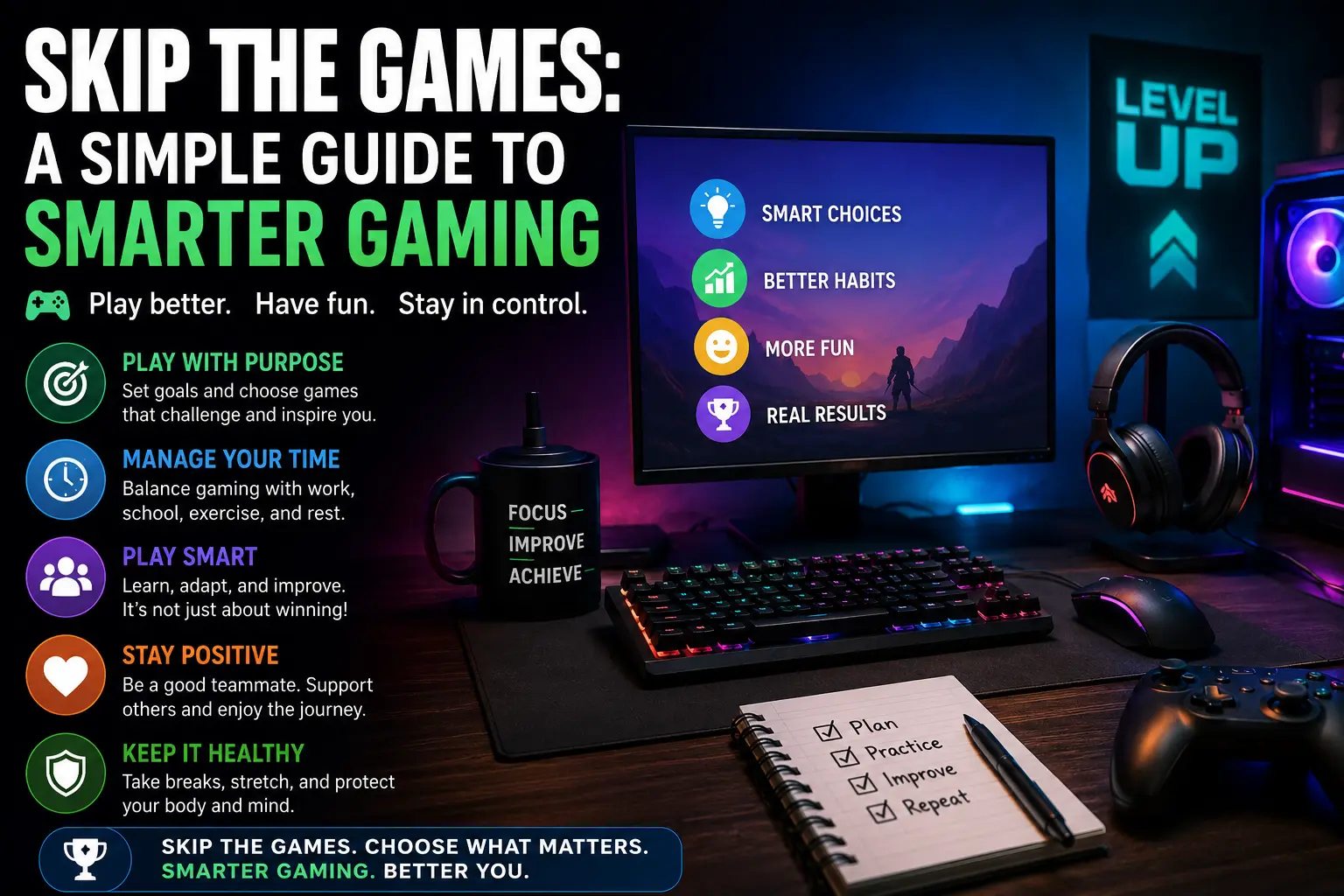
Do you ever feel like your game library is a to-do list? You buy a new title, play for a few hours, and then it starts to feel like work. There are long talking scenes you don’t care about. There are boring walks across huge maps. There are tasks that ask you to kill the same monster fifty times. Then you look at the clock and wonder where your evening went.
If that sounds like you, this post is for you. The idea is simple: skip the games that don’t make you happy, and skip the parts of games that waste your time. Gaming should be fun. It should not feel like a second job.
In this guide, we will talk about what it means to skip the games, why so many players want to do it, and how to do it the smart way. You will learn what you can skip inside a game, which games to skip before you even buy them, and how to keep the fun while cutting the stress. We will keep everything easy and clear, so you can use these tips today.

What Does “Skip the Games” Mean in Gaming?
In daily life, people use the phrase “skip the games” to mean “stop wasting time and get to the point.” In the gaming world, it has a few meanings that all fit together.
First, it can mean skipping parts inside a game. This includes cutscenes, long tutorials, repeated tasks, and slow travel. Many modern games even give you a skip button for this.
Second, it can mean skipping whole games. Maybe a game is not for you. Maybe it is too long, too costly, or just not fun. Choosing not to play it is a smart move, not a failure.
Third, it can mean skipping the “game-like” tricks that some titles use to keep you hooked. Daily login rewards, timers, and endless chores are all designed to make you come back, even when you don’t enjoy it.
When you learn to skip the games in all three ways, you take control of your free time. You stop playing because you feel you have to and start playing because you want to.
Why So Many Gamers Want to Skip the Games
Gaming has changed a lot. A few years ago, many games could be finished in ten or fifteen hours. Today, many big titles ask for sixty, eighty, or even a hundred hours. That is a lot of time for someone with a job, school, or a family.
Here are some common reasons players want to skip the games or parts of them.
1. Time is short: Most adults have only an hour or two each night. If a game needs long sessions to feel rewarding, it can be hard to enjoy.
2. The backlog is huge: Sales make it easy to buy games at low prices. Soon you own more games than you could ever finish. Every new purchase adds to the pile, and the pile adds stress.
3. Some parts feel like filler: Many games stretch their story with extra tasks that add time but not fun. Players often call this “padding.” It makes a good game feel slow.
4. Players want the story, not the struggle: Some people love a great story but do not enjoy hard fights or tricky puzzles. They want to see how the tale ends without getting stuck.
5. Money matters: Some games push you to spend money to move faster. Skipping those games, or skipping the paid shortcuts, can save a lot of cash.
6. Burnout is real: Playing too much of the same thing can drain the joy. Taking a break, or leaving a game for good, helps you feel fresh again.
None of these reasons are wrong. They are normal feelings that many players share. Once you accept this, it gets much easier to make choices that fit your life.
What You Can Skip Inside a Game
Let’s look at the parts of games that players most often want to skip. Not every game lets you skip them, but many do. Even when there is no skip button, there are usually other ways to move faster.
Cutscenes and Story Scenes
Cutscenes are the short movies that play between action. Some are beautiful and tell a deep story. Others are long and slow. Many games let you press a button to skip them.
If you love the story, watch them. If you only care about the action, skipping is fine. A good middle path is to watch the first time and skip them on a second playthrough, or watch the big story moments and skip the small talk.
Tutorials and Hints
Tutorials teach you how to play. They are very helpful when you are new. But if you have played many games of the same kind, you may not need them. Look for a “skip tutorial” option in the menu. If it is not there, you can often rush through the steps quickly, since they usually give you no real challenge.
Long Dialogue
Some role-playing games have many characters who talk for a long time. If you want to speed things up, you can use the button that moves the text along fast. Some games let you turn on auto-play, so the lines move without you pressing anything. Others let you read the text and skip the voice.
Grinding
Grinding means doing the same task again and again to earn points, items, or levels. A little grinding can feel relaxing. Too much of it feels like a chore. To skip the games’ grinding parts, you can lower the difficulty, use items that boost your experience, or choose a path that gives bigger rewards for less work.
Slow Travel
Walking across a giant map can be fun the first time. By the tenth time, it is boring. Many games have fast travel, which lets you jump to places you have already visited. Use it. There is no prize for the longest walk.
Side Quests
Side quests are extra tasks outside the main story. Some are wonderful and have great stories of their own. Others are simple errands that only fill your time. If you feel tired of them, skip them and go back to the main path. You can always return later if you miss them.
Mini-Games
Card games, fishing, racing, and puzzles inside bigger games are often fun breaks. But some are required for a story step, and they can be frustrating. If a mini-game is stopping you, check the settings. Many games let you skip it or make it easier.
Repeated Boss Fights
Few things make players feel more stuck than a boss they cannot beat. If you have tried many times and it is no longer fun, you have options. You can lower the difficulty, change your gear, look up a tip, or take a short break. Some games even offer a skip after you fail a few times.
Is It Okay to Skip the Games? Or Is It Cheating?
This is a question many players ask. The honest answer is simple: it is your game and your time.
Cheating is about breaking the rules in a game where other people are playing against you. If you are in a ranked match and use a hack to win, that is unfair. But when you play alone, and you skip a scene or lower the difficulty, you hurt no one. You are only shaping your own experience.
Some players say that skipping parts means you “did not really play the game.” That is an old idea, and it does not hold up well. People read books and skip slow chapters. People watch shows and skip the intro. Nobody calls them cheaters. Games are no different.
There is one good point in the other side, though. Some games are built so that the hard parts are the heart of the fun. If you skip every challenge in a game made around challenge, you may find it empty. The key is to know what you want from the game.
Ask yourself two questions:
- What do I enjoy most about this game?
- What parts make me want to quit?
Keep the first. Skip the second. That is the whole secret.
How to Skip the Games the Smart Way
Now let’s get practical. Here are simple steps that help you cut the boring parts and keep the joy.
Step 1: Know Why You Are Playing
Before you start a game, decide what you want. Do you want a fun story? A hard test of skill? A relaxing way to end the day? If you know your goal, you can see quickly when the game is not giving you what you need.
Step 2: Look Through the Settings First
Many players never open the settings menu, but it holds a lot of power. You can often change the difficulty, turn on auto-play for text, speed up animations, and adjust how fast the story moves. Spend five minutes in the menu before you start. It can save you hours later.
Step 3: Use Fast Travel and Quick Options
Whenever a game gives you a quick way to move, use it. Fast travel, skip buttons, and auto-save are there for a reason. Developers know that players have limited time.
Step 4: Play in Short Sessions
You do not need to play for four hours at a time. Many games are great in thirty-minute sessions. Pick a stopping point, like finishing one quest, and then take a break. This keeps the game fresh and keeps you from feeling worn out.
Step 5: Read or Watch a Guide for the Boring Parts
If a puzzle has you stuck, or you cannot find an item, it is fine to look up the answer. A short tip can save you an hour of wandering. Think of it as asking a friend for help.
Step 6: Set a Limit for Each Game
Some players decide that if a game is not fun after a set number of hours, they will stop. Many pick two to five hours as a test. This way you do not waste weeks on something you do not like.
Step 7: Let Yourself Quit
This may be the hardest step. If a game does not make you happy, you are allowed to stop playing. You do not owe it your time just because you paid for it. The money is already spent. Your time is still yours.
Skip the Games You Should Not Buy
Skipping does not only happen while you play. It starts at the store. One of the best ways to enjoy gaming more is to skip the games that are not worth your money or your time.
Check the Length and Style
Before you buy, check how long the game takes and what style of play it uses. If you only have a few hours each week, a hundred-hour adventure may not fit. A short game might be a better match.
Read Honest Reviews
Look at reviews from players, not just big headlines. Pay attention to what people say about pacing, bugs, and filler. If many people say the first ten hours are slow, trust them.
Watch Gameplay Videos
A few minutes of real gameplay tells you more than any trailer. You can see how the game feels, how fast it moves, and whether the menus are easy to use.
Check the Refund Rules
Many stores have rules that let you return a game if you have played only a short time. These rules are different on every store and can change, so read the current policy before you buy. Knowing you can return a game takes away a lot of risk.
Wait for a Sale
New games are often cheaper a few months later. If you can wait, you will save money, and you will also see how the game is doing once the early excitement fades. Some of the best buys are games that have been out for a while and have all their fixes in place.
Tackle Your Backlog First
Here is a simple rule: before you buy a new game, finish or drop one you already own. This keeps your pile from growing. It also reminds you that you may already have something great to play.
Skip the Games That Waste Your Money
Some games are free to start but push you to spend money again and again. This is common in mobile and online games. It is worth knowing how these tricks work, so you can skip the games that use them.
Timers and Waiting
Some games make you wait for a long time before you can do the next thing. Then they offer to let you skip the wait for a fee. The wait is part of the design. It is meant to make you pay or come back every day.
Loot Boxes and Random Rewards
Loot boxes are packs with random items inside. You pay without knowing what you will get. It can feel like a slot machine. If you find yourself spending more than you planned, that is a sign to stop.
Pay-to-Win
In some games, players who spend money become much stronger than those who do not. That can make the game feel unfair. If you want a fair game, look for titles where skill matters more than your wallet.
Daily Login Pressure
Many games give you rewards for logging in every day. Missing a day can feel bad, which keeps you hooked. But you are not required to join in. It is fine to let the streak go.
A Simple Rule for Spending
Set a small monthly gaming budget. When it is gone, it is gone. This keeps gaming fun and stops it from turning into a money problem. If a game keeps pushing you to go over your budget, skip the games like that and find a better one.
Skip the Games and Still Enjoy the Story
Many people love stories in games but do not have the time or skill to play every hard part. If that is you, you have good options.
Use story mode: Many games have an easy setting made for people who want to enjoy the tale. Enemies are weaker and puzzles are simpler, so you can keep moving.
Pick games built around story: Some games are made mostly for their story, with little fighting. These are great if you want to feel like part of a movie or book.
Watch a story summary: If a game is too long or too hard, you can watch a video that tells the whole story. This is not the same as playing, but it lets you enjoy the tale and talk about it with friends.
Mix it up: You can play the first part, skip the middle, and come back for the ending. It is your choice.
The goal is to enjoy yourself. There is no single right way to experience a game.
Skip the Games and Keep a Healthy Balance
Gaming is a great hobby. But like anything, it works best when it fits with the rest of your life. Sometimes “skip the games” also means giving yourself a break.
Here are some signs you may need a pause:
- You feel tired or cranky after playing.
- You are skipping sleep or meals to play.
- You are missing time with friends or family.
- You feel stress, not joy, when you play.
- You keep playing even when you are not having fun.
If you notice these signs, try a short break. Go for a walk, call a friend, read a book, or try a new hobby. When you return, the games will still be there, and they will likely feel better.
For Parents
If you are a parent, you may want to help your child skip the games that are not right for their age. Check the rating on each title, and look at the chat and spending features. Talk about limits together, so it does not feel like a punishment. Playing together is also a great way to see what your child enjoys.
Common Mistakes to Avoid
When people start to skip the games, they sometimes make a few simple mistakes. Here is how to avoid them.
Skipping everything: If you skip every scene and every challenge, the game may feel flat. Skip only the parts you truly dislike.
Feeling guilty: Some players feel bad about quitting a game they paid for. Remember that your time matters more than the price.
Following the crowd: A game may be very popular and still not be right for you. Trust your own taste.
Buying too many games at once: Big sales are tempting. Buy only what you will actually play soon.
Ignoring the settings: Many problems have easy fixes in the menu. Check there first.
Forgetting to try new things: Skipping the games you do not enjoy leaves room to find ones you love. Stay curious.
A Quick Checklist to Skip the Games Wisely
Keep this list handy the next time you start or buy a game:
- I know what I want from this game.
- I checked the settings for skip, speed, and difficulty options.
- I read honest reviews and watched real gameplay.
- I have a time or money limit.
- I am okay with quitting if it stops being fun.
- I am finishing or dropping my backlog before I buy more.
- I am taking breaks and keeping a healthy balance.
Frequently Asked Questions
What does it mean to skip the games?
In gaming, it means skipping parts of a game you do not enjoy, skipping whole games that do not suit you, or skipping tricks that waste your time and money. It is about choosing fun over pressure.
Is it bad to skip cutscenes?
No. It is your choice. If you like the story, watch them. If you want more action, skip them. Many games even include a skip button for this reason.
How can I finish a long game faster?
Focus on the main story, use fast travel, lower the difficulty if you want, and skip side tasks that do not interest you. Short, regular sessions also help.
Should I finish every game I start?
Not at all. If a game is not fun, you can stop. Your free time is limited, so spend it on games you enjoy.
How do I stop buying games I never play?
Set a budget, wait for sales, read honest reviews, and finish or drop a game you already own before buying another.
Are free games really free?
Some are, but many make money from timers, loot boxes, and paid shortcuts. Watch your spending and set a limit before you start.
Does skipping parts of a game ruin it?
It can if you skip what the game does best. That is why it helps to know what you enjoy about it. If you skip only the dull parts, the game can feel even better.
How do I know when to take a break from gaming?
If you feel tired, stressed, or bored when you play, or if gaming is getting in the way of sleep, work, or friends, it is a good time to pause.
Final Thoughts
Gaming should add joy to your life, not take it away. When you choose to skip the games that do not fit you, skip the boring parts inside the ones you play, and skip the tricks that waste your money, you get more of what you love.
Remember the main ideas. Know why you are playing. Use the settings and skip tools your games give you. Check reviews and set limits before you buy. Give yourself permission to quit. And take breaks when you need them.
Your time is valuable, and so is your fun. The next time a game starts to feel like a chore, ask yourself a simple question: Is this still making me happy? If the answer is no, you know what to do.
Skip the games that do not serve you, and enjoy the ones that do.
